What is a connected worker platform?
A connected worker platform is a software system that digitises and optimises the work of frontline manufacturing operators. It sits at the intersection of communication, knowledge management, task coordination, and real-time visibility. At its core, it does one thing: it gives operators the information, instructions, and feedback they need to work safely, efficiently, and consistently without walking away from the floor.
Connected worker platforms are not new. The concept traces back to paperless manufacturing initiatives in the 1990s and early digital-first manufacturing efforts in the 2000s. What has changed is the technology. Cloud connectivity, mobile devices, and APIs have made it possible to build platforms that integrate with the full ecosystem of manufacturing systems: ERPs, MES platforms, SCADA, asset management, and HR systems.
The term itself is modern, popularised by Gartner's research into frontline digitisation and adopted by software vendors starting around 2018. But the underlying problem is as old as manufacturing itself: operators work in an information deficit. They receive instructions verbally, from memory, or from faded printed sheets. They don't see real-time performance data. They can't easily escalate issues or share knowledge with colleagues. A connected worker platform closes these gaps by making digital guidance, visibility, and communication the default.
The problem it solves
Manufacturing floors are fragmented. Instructions live on paper, in emails, or in people's heads. Quality and performance data are collected in spreadsheets and analysed hours or days later. When a machine stops, the operator doesn't know if it's a known issue with a documented fix, or if someone six stations down just solved the same problem. Training is episodic rather than continuous. Compliance is tracked at the document level, not the person level.
This fragmentation creates several cascading problems:
Operator confusion and variation
Different operators follow different procedures for the same task, leading to inconsistent output quality and prolonged changeovers. When procedures exist only on paper, they decay. The last person to revise the sheet may have made changes that aren't known to others.
Reactive problem solving
When something goes wrong, operators troubleshoot independently or call for help. The same issue might be solved differently across shifts. Solutions don't propagate. Every problem is treated as if it's being solved for the first time.
Lost knowledge
Experienced operators carry deep institutional knowledge: how to make the line run fast, what hidden adjustments work, how to prevent failures. When they leave, that knowledge walks out the door. Newer operators take years to accumulate the same expertise.
Visibility lag
Performance data arrives late. A daily report on yesterday's OEE is too late to act on today's losses. Supervisors make decisions based on anecdotal reports rather than data, or decisions are delayed because the data isn't ready.
Core capabilities
Connected worker platforms vary widely in functionality, but most converge on a set of core capabilities that address the problems above:
Digital Standard Operating Procedures (SOPs)
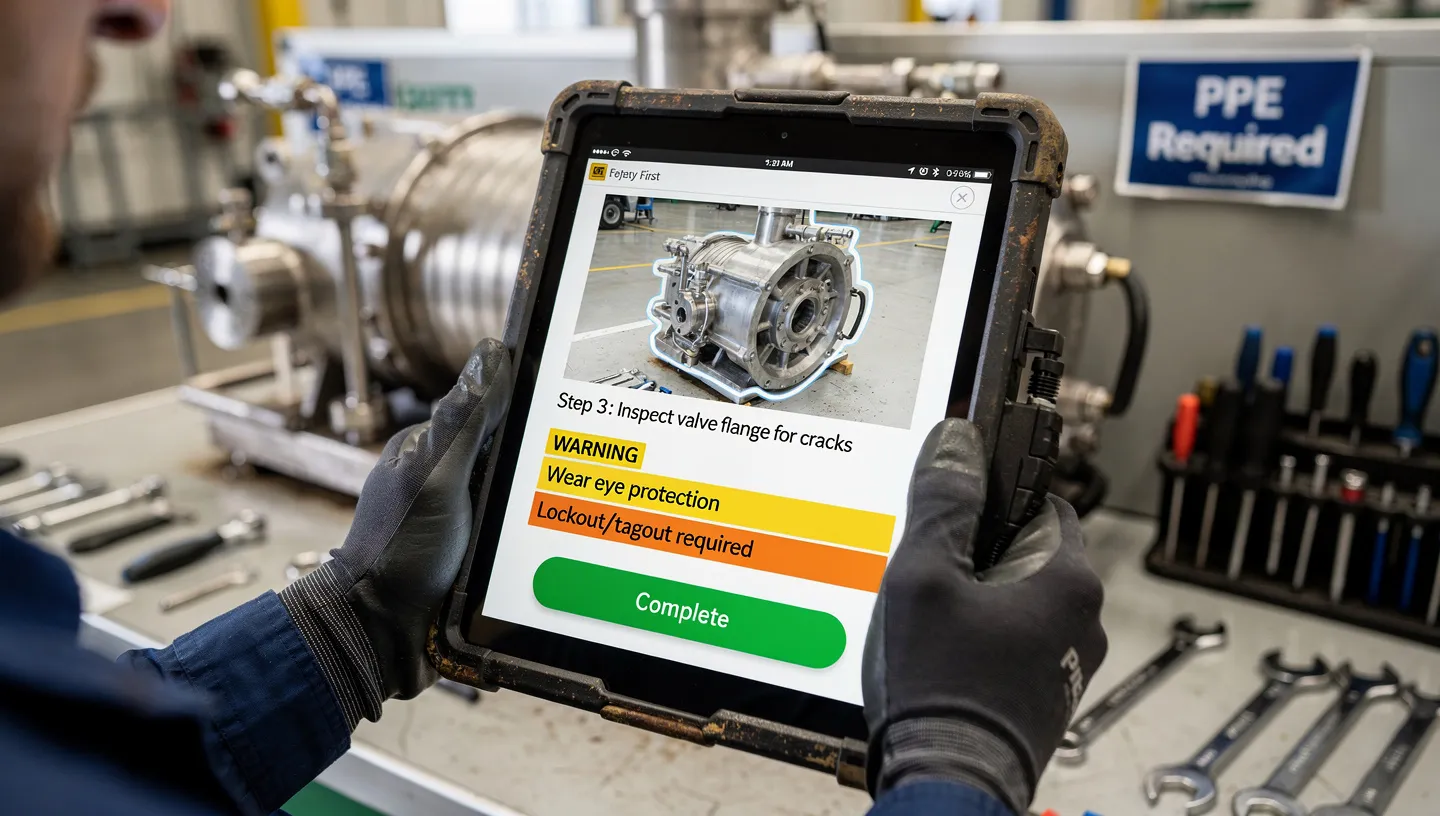
Structured, versioned procedures that operators can view on mobile devices or tablets at the workstation. SOPs include photos, videos, step-by-step checklists, quality checkpoints, and decision trees. Operators sign off electronically, creating a compliance record. Changes to procedures are version-controlled and push automatically to all relevant stations.
Task and work order management
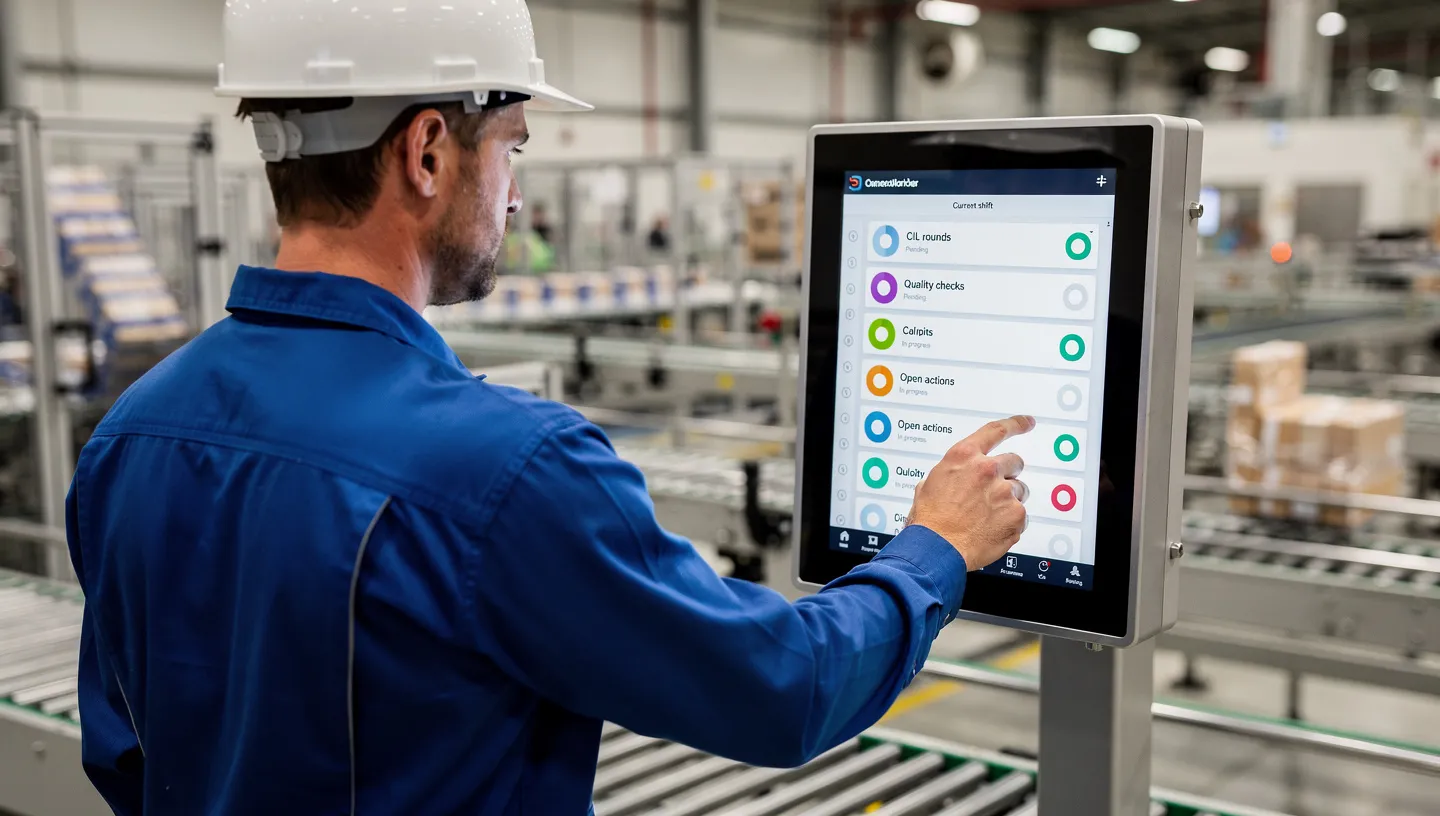
Operators receive prioritised work instructions on their device: "Run batch 2847 on line 4" or "Complete preventive maintenance on pump B6." Tasks include all relevant documentation, tools checklist, safety alerts, and estimated duration. Operators update status in real time.
Real-time performance visibility
Dashboards show production counts, quality metrics, OEE, and loss events as they happen. Operators see their own performance and their line's performance live, creating immediate feedback. Some platforms include predictive alerts ("Based on current run rate, you'll exceed scrap quota at 3pm").
Knowledge capture and issue logging
When an operator encounters a problem, they log it with a photo, description, and categorisation. The platform can route issues to maintenance, quality, or engineering based on type. Knowledge from similar past issues is surfaced ("Last time this happened, the solution was X"). Over time, this becomes an institutional knowledge base of solutions.
Training and skills management
The platform tracks which operators are qualified to run which equipment or perform which tasks. Training content is available on demand, with completion tracking. Some platforms include micro-learning modules that operators can complete during downtime. Certification status is enforced at the task level: if an operator isn't qualified, they can't be assigned that task.
Safety and compliance
Safety procedures and hazard alerts are built into SOPs and task instructions. Pre-shift safety briefings are managed through the platform. Lockout-tagout compliance and safety incident reporting are digital and timestamped. Audit trails ensure accountability.
Not every platform includes every capability. Some focus on task management and procedure delivery. Others emphasise knowledge capture and training. The most mature platforms integrate all of these as a cohesive system, where a single SOP can trigger a task, record training completion, and log performance data simultaneously.
Connected worker vs MES vs CMMS vs ERP
The manufacturing software landscape includes several overlapping categories. It's important to understand where connected worker platforms fit and how they relate to (but differ from) other systems.
| System | Primary user | Time horizon | Data flow |
|---|---|---|---|
| Connected Worker | Operators and team leaders | Real-time and in-the-moment | Two-way: instructions down, performance and issues up |
| Manufacturing Execution System (MES) | Supervisors, engineers, planners | Shift and daily | Two-way: orders to floor, production data back |
| Computerised Maintenance Management System (CMMS) | Maintenance technicians, planners | Scheduled and reactive | Two-way: work orders out, completion back |
| Enterprise Resource Planning (ERP) | Finance, supply chain, planning | Transactional and reporting | One-way: order creation, inventory updates |
Connected Worker vs MES: An MES is the nervous system of a manufacturing plant, coordinating what gets made, when, and in what quantity. A connected worker platform is the interface between that system and the operators. The MES tells the platform what order to run next; the platform tells the operator how to run it. An MES provides plant-level visibility and optimisation; a connected worker platform provides operator-level guidance and feedback. A plant can have an excellent MES without a connected worker platform (and must navigate relying on paper to communicate to operators). Conversely, a plant can improve operator effectiveness with a connected worker platform even without a formal MES, though integration with an MES multiplies the benefit.
Connected Worker vs CMMS: These systems serve different workflows. A CMMS schedules and tracks maintenance work: preventive maintenance intervals, work order assignment, parts management, history. A connected worker platform manages production tasks and procedures. A CMMS might generate a work order ("Service pump B6 on Monday"); a connected worker platform might push that work order to the right technician's device and provide the service SOP. In integrated plants, the two systems communicate: when a maintenance work order is completed in the CMMS, it notifies the MES to resume production; when an operator logs an issue in the connected worker platform, it can auto-create a CMMS work order.
Connected Worker vs ERP: An ERP is the financial and planning backbone: managing inventory, purchase orders, sales orders, and accounting. It rarely interacts directly with operators. Its interaction with the manufacturing floor is indirect, through the MES. A connected worker platform might pull product information or customer specifications from the ERP (e.g., "this batch is for a high-criticality customer, so quality checks are stricter"), but the real-time operational interface is the connected worker platform, not the ERP.
The operator experience
The best way to understand what a connected worker platform does is to walk through a typical operator's shift using one.
Start of shift: The operator clocks in, and their device displays their assignment: three production runs and a preventive maintenance task. They also see a safety briefing and a message from their supervisor about a known quality issue on this product line that occurred yesterday. They review the safety briefing (2 minutes) and acknowledge it (creating an audit trail).
First run: They navigate to Run 1: "Produce 500 units of Product A, variant B47." The system displays the setup SOP, complete with photos showing the correct settings for the changeover. They follow the steps, checking them off as they go. When they're done, they confirm "setup complete." The system automatically logs this and notifies the supervisor. They start production. As they run, a real-time counter on their device shows units produced, scrap count, and current OEE. A minor jam occurs; they pause production, fix it, and log it on their device: "Jam in feeder, debris in hopper" with a photo. The issue is automatically routed to maintenance.
Mid-shift: Run 1 completes. They move to Run 2. The device displays an alert: "You haven't completed the Tier 2 Safety training that expires next week. You can complete it now during this 15-minute changeover." They opt in and spend 12 minutes on the micro-learning module. The platform records completion and updates their certification status.
Issue escalation: During Run 2, they notice something wrong with the product: dimensions are slightly off. They photograph a part, add a note ("Dimensions running 0.3mm high"), and send it to Quality Engineering. Within an hour, they receive a response: "Confirmed, adjust setting X by 2 clicks. Similar issue two weeks ago, setting drift over time. Guide attached." They make the adjustment and resume normal production.
End of shift: They complete their assigned runs and the maintenance task. The system displays a summary: 1,247 units produced, 12 scrap, two issues logged, one safety training completed. They clock out. The shift supervisor reviews the daily summary on their own dashboard: overall OEE, quality metrics, completion status of all tasks, and a list of issues for tomorrow's priorities meeting.
Integration and ecosystem
A connected worker platform's value multiplies when it's integrated with the rest of the manufacturing IT ecosystem. The key integration points are:
ERP integration: Product data, customer specifications, and order information flow from the ERP to the platform. An operator can see not just "make 500 units" but "make 500 units of this customer's order, with these specifications, and this lead time." This context drives decision-making and quality focus.
MES and SCADA integration: Production schedules, production counts, and equipment status flow from the MES or SCADA into the platform. In the best cases, the platform can automatically log start and end times for production runs, eliminating manual data entry. It can also receive real-time equipment alerts ("Motor temperature high") and surface them to the operator before a failure occurs.
Single Sign-On (SSO): If the platform supports LDAP, Active Directory, or SAML, operators log in once with their network credentials. This reduces credential management overhead and ensures that access revocation is immediate.
Universal Numbering System (UNS): Some automotive and aerospace suppliers use a standardised product code that's recognized across systems. Platforms that support UNS can automatically match customer product specifications to internal SKUs.
Business intelligence and Power BI: Many platforms can export data to Power BI or similar BI tools, allowing supervisors and engineers to build custom dashboards on top of the operational data. This supports trend analysis, predictive maintenance, and strategic reporting that the platform doesn't natively provide.
Slack, Teams, email: Some platforms push alerts and summaries to Slack or Teams channels, or send email reports to supervisors. This keeps critical information visible without requiring people to log into yet another application.
Common pitfalls in selection and rollout
Connected worker platform implementations often stumble on predictable issues. Learning from these pitfalls can dramatically improve the chance of successful adoption:
Treating it as a technology implementation, not a change initiative
The biggest failure mode is buying a platform, rolling it out without operator involvement, and expecting it to be used. Operators didn't ask for this. They work on paper or memory because that's how they've always worked. The platform changes their routine and adds steps (pulling out a device, logging in, clicking through screens). Without buy-in from operators, supervisors, and team leaders, the platform gets used minimally or abandoned. Success requires training, support, visible leadership endorsement, and patience during the ramp-up period.
Trying to digitise broken processes
If your procedures are outdated, inconsistent, or poorly documented on paper, digitising them in the platform won't fix that. You'll just have broken procedures on a digital device. The platform should automate and enforce good processes, not digitise bad ones. This means investing in procedure review and standardisation before, or alongside, the platform implementation.
Choosing the platform before defining what operators need
Some plants pick a platform based on features, price, or vendor reputation, then try to fit their operations to the tool. The better approach is to define what operators actually need (what guidance, what visibility, what communication channels), then find the platform that serves those needs. A task management platform is wrong for a plant that needs deep SOP management. A knowledge capture platform is wrong for a plant that needs to tightly control changeover procedures.
Data quality disasters
If the platform is pulling production counts from an MES or SCADA, but the data is latent, unreliable, or inconsistent, operators will lose faith in the numbers. The platform will show "OEE = 63%" but the operator knows it's higher because they only had one brief stop. Credibility is lost. This requires testing integration data quality before launch and having a team ready to debug data issues early.
Underestimating ecosystem friction
A connected worker platform is useful only if the right information is available at the right time. If SOPs are locked in a SharePoint that requires VPN access, or product specifications are in an ERP that the platform can't query, or maintenance schedules are in a separate CMMS with no integration, the platform becomes a one-way communication tool. It works best when it's truly integrated into the workflow.
Mobile-first design that ignores the stationary workstation
Some platforms are built for mobile phones, with the assumption that operators roam. But many manufacturing operations have fixed stations. Operators need a tablet or a wall-mounted screen, not just a phone. A mobile app that works beautifully on a phone but requires constant scrolling and pinching on a tablet will be rejected.
Measuring ROI
Connected worker platform implementations generate value across several dimensions. Measuring that value requires understanding the baseline first.
Improved first-pass quality: When operators have clear, updated instructions available at the workstation, defect rates typically decrease. A plant with 2.5% scrap that reduces to 1.8% scrap through better guidance has eliminated 25% of scrap. If annual production is 2 million units at $50 per unit, that's $700,000 of waste prevented annually.
Faster changeovers: Changeover time often improves by 15 to 30% in the first year after implementation. Operators don't need to search for setups, consult colleagues, or interpret ambiguous written procedures. If changeovers average 45 minutes and improve to 35 minutes, and a production line does three changeovers per shift, that's 30 minutes per shift of recovered production time. Over a year, that's a significant capacity gain.
Reduced downtime and faster troubleshooting: When operators can quickly access solutions to known issues ("This jam happened two weeks ago, here's the fix"), or when issues are logged and routed to the right person immediately rather than waiting for the next break, mean-time-to-repair (MTTR) decreases. A 10-minute reduction in MTTR per incident across dozens of incidents per month adds up to hundreds of hours of recovered uptime annually.
Training acceleration: New operators are productive faster when they have on-demand access to training and guidance, rather than waiting for a trainer to be available. Training time-to-competency can decrease from 4 weeks to 2-3 weeks, reducing labour cost per trained operator and getting capacity online faster.
Compliance and risk reduction: Digital audit trails, enforced training completion, and timestamped procedure adherence reduce regulatory risk and incident frequency. For regulated industries (aerospace, pharma, automotive), this compliance value alone can justify the platform investment.
Harder-to-measure value: Knowledge retention, institutional learning, continuous improvement momentum, and supervisor decision quality all improve but are harder to quantify. A plant that captures and reuses solutions improves faster than one where every problem is solved independently.
The future of connected work
Connected worker platforms are evolving rapidly. Several trends are reshaping what these systems can do:
AI-assisted workflows: Computer vision can inspect photos of quality issues and suggest the most likely root cause. Natural language processing can help operators describe problems in their own words, with the platform categorising and routing them automatically. Predictive models can surface the solution before the operator even reports the issue.
Augmented reality (AR): Instead of following a text and photo SOP, operators will wear AR glasses that overlay instructions directly onto the equipment. "Put your finger here," "turn this dial three clicks," "watch for this indicator." This is especially powerful for complex changeovers or repairs.
Generational shift: Younger operators entering manufacturing have grown up with smartphones and expect digital tools. A plant without a connected worker platform will find it harder to recruit and retain talent, especially as competitors offer digital-first environments.
Consolidation around platform ecosystems: Rather than a point solution for task management, plants will adopt integrated ecosystems where the connected worker platform is the central nervous system. It coordinates with MES, CMMS, ERP, IoT sensors, and BI tools seamlessly. Single-vendor solutions will compete with best-of-breed integrations.
Decentralised knowledge systems: As more plants treat SOPs, training, and solutions as living assets that are constantly updated and improved, decentralised knowledge management (wiki-like systems where operators can contribute) may become standard, replacing centrally-managed document repositories.
Privacy and security at the edge: As plants digitise more of the operator workflow, security and data privacy become critical. Future platforms will likely embed privacy controls, encryption, and offline-first architectures that let operators work even when cloud connectivity is lost.