Maecos Operations

Everything operators do on the floor

Standard work execution. Issue management and root cause analysis. Shift handovers built from real data. Performance meetings that produce tracked actions. Seven modules that share context, so nothing falls between the cracks.
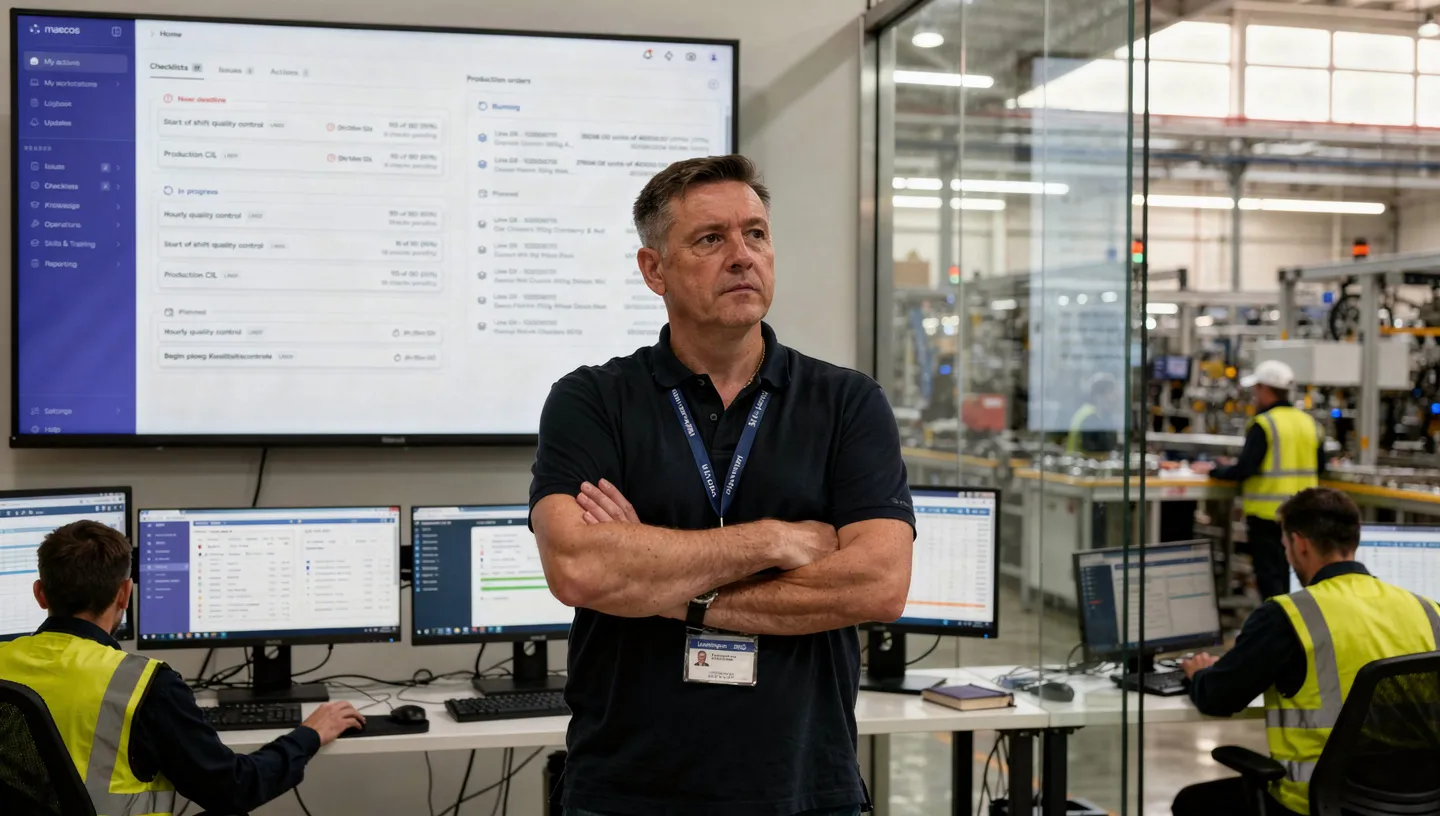
Control room operator reviewing shift data on the Maecos platform in a food manufacturing plant
7 modules one connected system, one login
96% average checklist compliance among active customers
Offline-capable works on the floor without Wi-Fi

Standard work that enforces the standard

Checklists gated by operator qualification. When a procedure changes, the checklist locks until retraining is complete. Every step captures readings, photos, and timestamps. Deviations flow directly into Issue Management with full context attached.

Qualification gatingDynamic templatesRich data capture5S · CIL · Gemba · BOS
Explore Standard Work
Operator completing a qualification-gated checklist on a tablet at a production line

Every issue traceable, from floor to root cause

Issues are logged directly from a checklist step, shift handover, or the floor itself. Photos, location, and linked procedures are captured automatically. AI surfaces similar past issues and their resolutions. Investigations produce actions that are tracked to closure.

AI root cause suggestionsSafety · Quality · EquipmentFull traceabilityPattern analytics
Explore Issue Management
Issue #247 · Quality deviation Investigation open
Out-of-spec reading. Line 3, Step 7 Critical
AI: 2 similar issues found Suggested
Root cause: Procedure gap Confirmed
Action assigned. Doc update In progress

Nothing lost between shifts

Handovers pre-populate from what actually happened: issues logged, checklists completed, actions pending. The incoming team starts informed. Every shift produces a searchable, audit-ready logbook entry. The night shift starts where the day shift left off.

Auto-populated handoverPer-line templatesDigital logbookCross-shift trends
Explore Shift Handover
Two operators reviewing the digital shift handover on a shared screen during shift change

Performance meetings that produce actions

Recurring meeting cadences with structured agendas: daily stand-ups, weekly reviews, monthly performance meetings. Live KPIs pulled from operations data. Every action assigned, tracked, and closed. Decisions don't disappear into someone's inbox.

Daily · Weekly · Monthly cadencesLive KPI dashboardsAction trackingTier 1/2/3 support
Explore Meetings & Performance
Weekly Review · Plant Manager Thursday 09:00
OEE this week, 87.3% ↑ +2.1
Open deviations, 7 3 new
Training compliance, 94% On track
Actions from last week, 8/10 closed 80%

Seven modules. One system.

Every module works standalone. Every module works better connected.

Connected to Maecos Learning

Operations and learning, connected by design

When an SOP changes, retraining triggers automatically. When training completes, the checklist unlocks. When a deviation is captured during execution, the system identifies whether it traces to a training gap.

No standalone LMS can do this, because it doesn't know what happens on the floor.

Maecos Operations
Standard Work Issue Management Document Management + 4 more modules
Connected by design
Maecos Learning
Training & Qualifications Skill Matrix Learning Paths

Common questions

Do I need to deploy all seven modules at once?

No. Most customers start with two or three modules during a paid pilot. Standard Work and Shift Handover is a common starting point. Modules share context, so adding a new one later is configuration, not a new integration project.

How does Maecos Operations relate to our existing MES?

Maecos sits between your MES and the operator. It handles execution, knowledge, and compliance on the shop floor. It integrates with your MES (and ERP, SCADA, etc.) through standard protocols. It doesn't replace your production control layer.

Can operators use it offline?

Yes. Checklist execution, issue logging, and handover entries all work without a network connection. Data syncs automatically when connectivity returns. No lost entries, no interruption.

How long does a typical pilot take?

Most pilots run 8 to 12 weeks on a single line. That's enough to demonstrate value on checklist compliance, handover quality, and issue resolution time. From there, customers decide on a phased rollout.

Six tools per shift. One system to replace them.

Standard work, issues, handovers, meetings, actions, dashboards, and documents. Connected. One login.