Actions come from everywhere, issues, meetings, audits, Gemba walks, shift notes, improvement ideas. In Maecos, they all land in one place. Every action carries its origin, its owner, and its deadline. Across every module, every shift, every team.
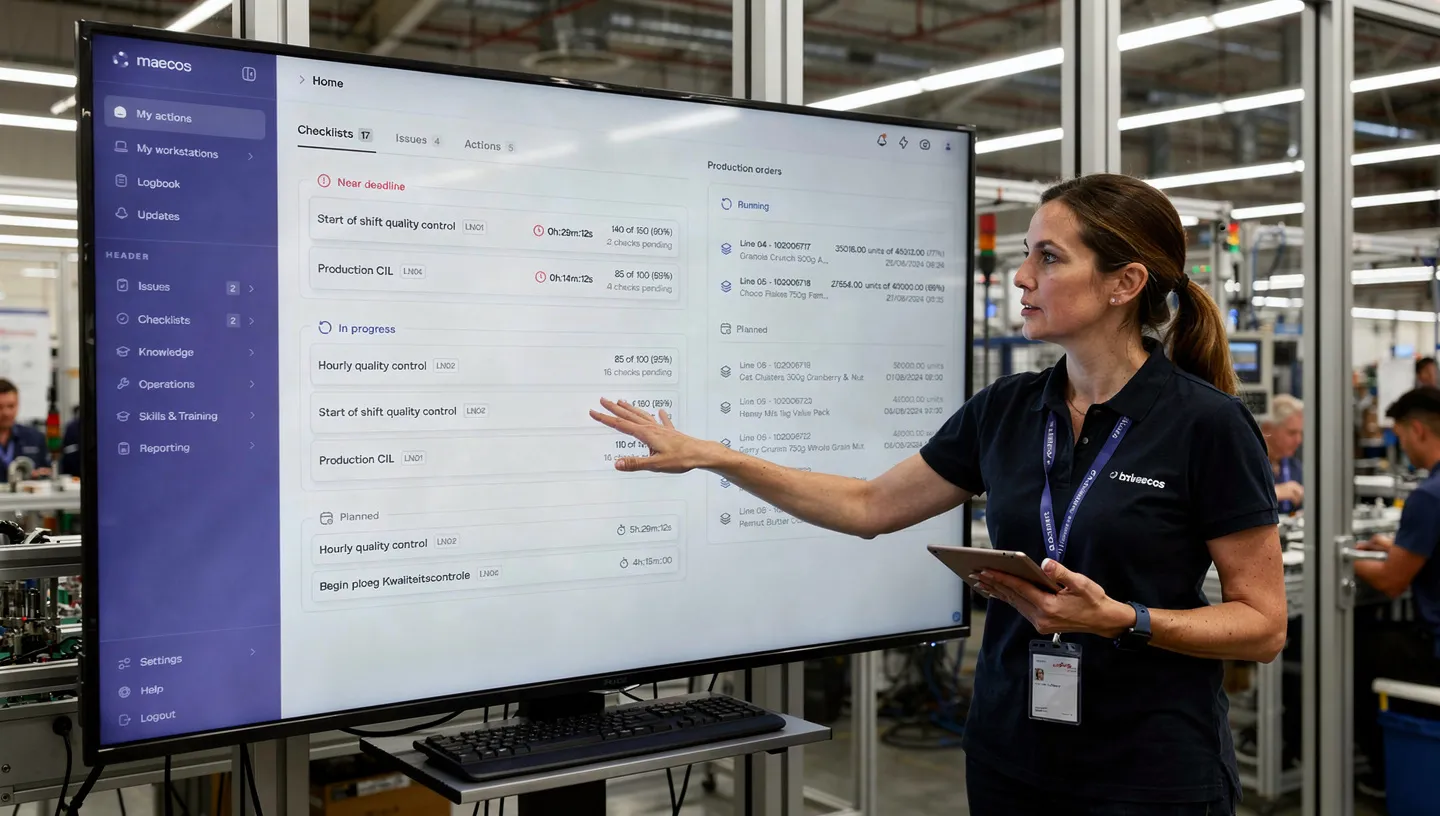
Actions created from Issue Management, Meetings, Standard Work, Shift Handover, Gemba walks, or manually. Every action carries its origin, so you always know why it exists and what it's connected to. An action born from a quality investigation shows up in the next shift handover, appears in Wednesday's performance meeting, and links back to the original issue. One action, full traceability, zero re-entry.
Kanban board, list view, timeline, or calendar. Filter by module, line, team, priority, or deadline. Overdue actions surface automatically, in meetings, in dashboards, in handovers. Managers see the full picture. Operators see what's theirs. Everyone sees what's overdue.
Escalation rules for overdue items, notifications, manager alerts, meeting agenda flags. Actions aren't just marked done: completion can require evidence, approval, or verification steps. Closed means closed, with a record of what was done and who verified it. No more “I think someone handled that.”
Short-term corrective actions and long-term improvement projects live in the same system. Link daily actions to A3 reports, Hoshin plans, or PDCA cycles. Track project progress with timeline or Kanban views. The action that started as a floor observation can become part of a structured improvement initiative, without switching tools.
An issue investigation identifies a procedure gap. A corrective action is created, linked to the issue, assigned to the process engineer, due in five days.
The action appears in the next shift handover for the relevant line. It shows up in Wednesday's performance meeting as an open item. On day four, the engineer completes the SOP update, attaches it to the action, and marks it for verification.
The team lead verifies. Action closed. The updated SOP triggers retraining. The loop closes.
The action that was assigned in a meeting and never mentioned again until the next audit. The improvement idea that was captured on a sticky note and lost during the next 5S round. The follow-up that everyone assumed someone else was handling.
Actions don't fail because people are irresponsible. They fail because they're scattered across tools that don't talk to each other.
“Actions used to disappear into personal to-do lists. Now every action has an origin, an owner, and a deadline, and it surfaces in every relevant context until it’s closed.”
— Continuous Improvement Lead, Chemical Manufacturing
Yes. Actions can be created from Issue Management, Meetings, Standard Work, Shift Handover, Gemba walks, audits, or manually. Every action carries a link back to its origin, so you always know why it exists and what triggered it.
Escalation rules are configurable per action type or priority level. Overdue actions can trigger notifications to the assignee, alerts to their manager, and automatic inclusion in meeting agendas and shift handover summaries. Nothing stays invisible.
Yes. Completion can require attached evidence (photos, documents, readings), an approval step by a team lead, or a verification workflow. Marked as done and actually verified as done are different. Maecos enforces the distinction.
Yes. Short-term corrective actions and long-term improvement projects coexist in the same system. You can link daily actions to A3 reports, Hoshin plans, or PDCA cycles and track project progress with timeline or Kanban views.
Cross-module action tracking, escalation rules, and verified closure, in one system.