What is shift handover?
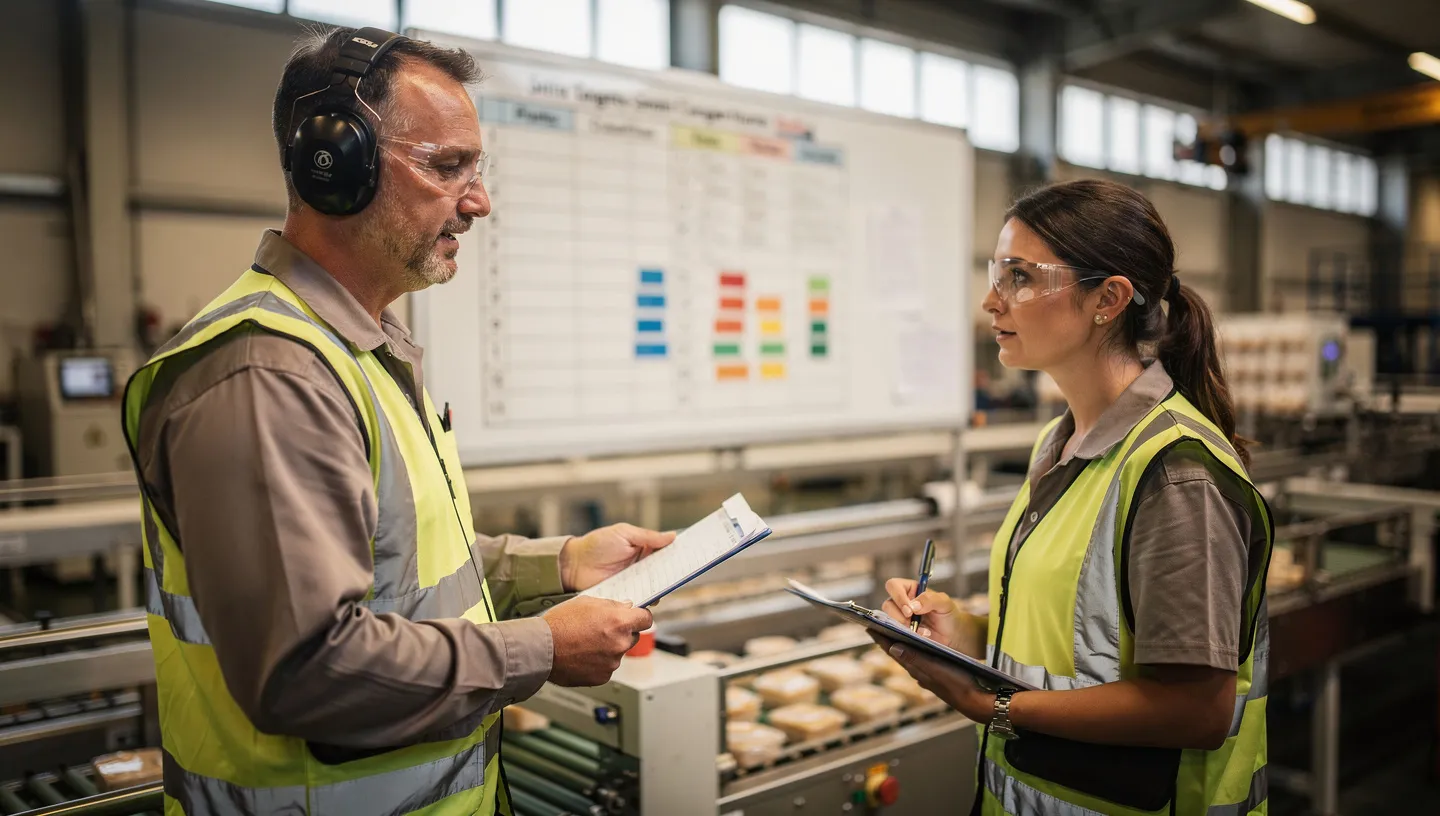
Shift handover is the formal transfer of operational responsibility from one team to the next. It happens at shift change, typically face-to-face, and is the moment when critical information about equipment status, open problems, and production targets moves from the outgoing shift to the incoming shift.
In manufacturing, the business is 24/7, but the workforce is not. Handovers are the glue that keeps operations continuous. Done well, they ensure that the second shift picks up exactly where the first shift left off, that no problems are dropped, and that progress toward production targets is uninterrupted. Done poorly, they are the place where information evaporates.
The stakes are high. A missed issue can cascade into the next shift. Repeated attempts to understand "what was happening" waste floor time. Operators rework decisions that were made and later forgotten. Production targets get compromised because the incoming shift didn't know what was already in flight.
Why handover matters
Information loss at shift change is one of the largest hidden sources of waste in manufacturing. Most plants do not measure it, which makes it easy to ignore. But the effects are visible everywhere: rework, duplicated effort, equipment running in suboptimal states, and decisions being remade.
Safety. If the outgoing shift encountered a hazard and did not communicate it clearly, the incoming shift may repeat the same unsafe action. Near-misses and near-hits that were not logged vanish from the safety record, preventing learning and system improvement.
Quality issues. A quality problem discovered late in the outgoing shift may take hours to root cause. If the findings are not passed to the next shift in written form, the investigation stalls and the problem repeats. Scrap from the first shift may not be fully understood when it arrives at the second shift, leading to duplicate failures.
Equipment status. An operator discovered that a sensor reads 10% high, so they developed a workaround. They mentioned it to the team lead before leaving. The next shift does not know this. They adjust the process based on the incorrect sensor reading, causing drift and eventual quality failure.
The "shift gap". Many plants see a regular dip in performance at shift change. Output drops, first-pass quality drops, and downtime increases during the transition hours. This is not inevitable. It is a sign that handover is breaking information flow.
What a good handover covers
Handover is not random conversation. It is a structured transfer of specific information categories, each of which affects what the incoming shift should do next.
Equipment status
Current state of each piece of equipment. Running normally? Known issues (sensor reading high, cam follower sticking)? Recent maintenance interventions? Anything the incoming shift needs to know about the equipment before running it.
Open issues
Problems discovered but not resolved. Equipment failures still under diagnosis. Quality issues being investigated. Process deviations. Each open issue should have an owner and status, so the next shift knows whether to continue troubleshooting, escalate, or let it wait.
Safety and near-misses
Any safety incident, near-hit, or hazard encountered during the shift. The fact that no one got hurt does not mean the situation is resolved. The next shift needs to know what to avoid or watch for.
Quality observations
Defects found, their frequency, root cause hypotheses, containment actions taken. If scrap was created, what was done about it? Does the next shift need to hold output for inspection?
Production targets and progress
What was scheduled to be produced? How much was actually produced? Why did actual differ from plan? What does the incoming shift need to do to catch up, if needed?
Actions and decisions
Decisions made and actions taken during the shift. Equipment parameters changed. Temporary fixes applied. Process deviations authorised. The incoming shift needs to understand what is in place and what is temporary.
Most handovers cover some of these topics loosely. A good handover covers all of them, in documented form that can be referenced if needed.
Handover formats
Different handover methods exist. Each has trade-offs.
Face-to-face conversation. The most common format: outgoing and incoming operators meet at shift change and talk. Advantages: rich communication, nuance, questions can be asked in real time. Disadvantages: no record, information is lost immediately after the shift, and detailed problem solving is not actually handover, it is engineering.
Logbook. A physical or digital notebook that operators fill in with notes and findings. Each shift reads the previous entry before starting. Advantages: permanent record, asynchronous (does not require both shifts to be present), searchable history. Disadvantages: incomplete entries, variable legibility, inconsistent format, and poor information architecture (finding the one relevant note in a 500-page book is hard).
Structured template. A form or checklist that guides what information to record. Categories like "equipment status," "open issues," and "targets." Advantages: consistency, completeness, easy to scan. Disadvantages: can feel bureaucratic, and written forms still lack real-time interactivity.
Walk-and-talk. Outgoing and incoming shift walk the floor together, reviewing equipment, checking status, discussing what is running well and what needs attention. Advantages: visual confirmation, opportunity to verify written notes, team building. Disadvantages: time-consuming, does not work if shifts overlap poorly, and still requires someone to capture findings.
No single format is correct. The format must match the plant's culture and operational constraints. A 24-hour operation with overlapping shift handover times can use face-to-face plus digital capture. A plant with non-overlapping shifts relies more on digital logbooks.
The digital logbook concept
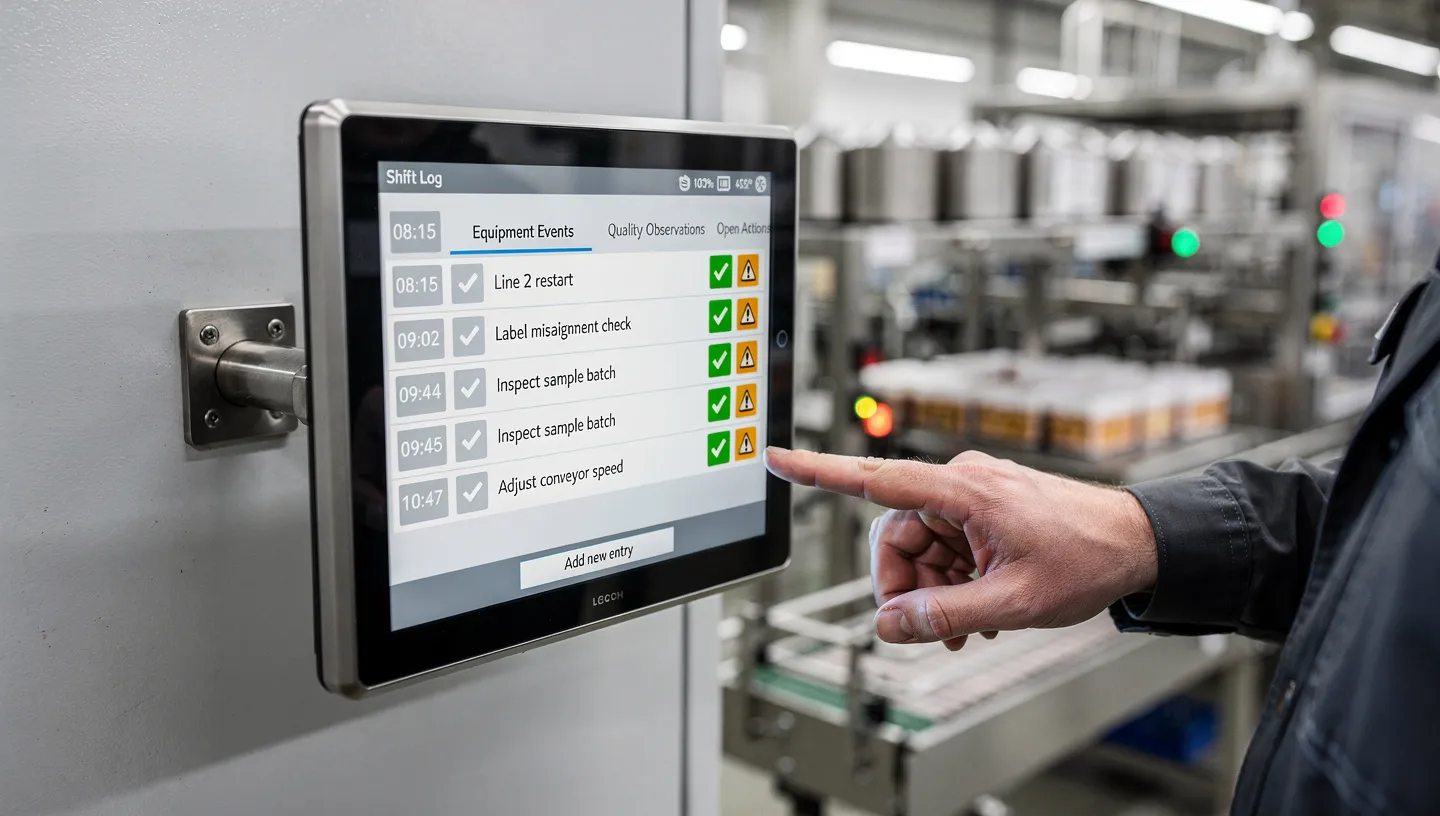
A digital logbook is an application where each shift records what happened, what is open, and what the next shift needs to know. It replaces the paper notebook with something searchable, structured, and integrated with the plant's production data.
A good digital logbook has these properties: entries are time-stamped and attributed to the person who wrote them; information is categorised (equipment issues, quality findings, safety events, actions); searches can find relevant entries by keyword or date; and the logbook integrates with or at least links to equipment history, defect records, and production targets.
The logbook is not a complaint book or a free-form diary. It is operational documentation. Entries should be factual, specific, and action-oriented. "The machine was acting weird" is not an entry. "Spindle temperature cycling between 68C and 74C, affects dwell accuracy on holes shallower than 0.5mm, causing rework. Coolant level checked OK. Thermal sensor re-seated. Will monitor and escalate if persists" is an entry.
Adoption of digital logbooks requires discipline. Team leaders must model the behaviour, operators must see that their entries are read and used to drive decisions, and the platform must be frictionless (bad user experience kills adoption immediately).
Handover and daily management
Shift handover is not isolated. It connects directly to the daily management system. In an operation running Integrated Work Systems (IWS), handover is part of the daily direction setting process.
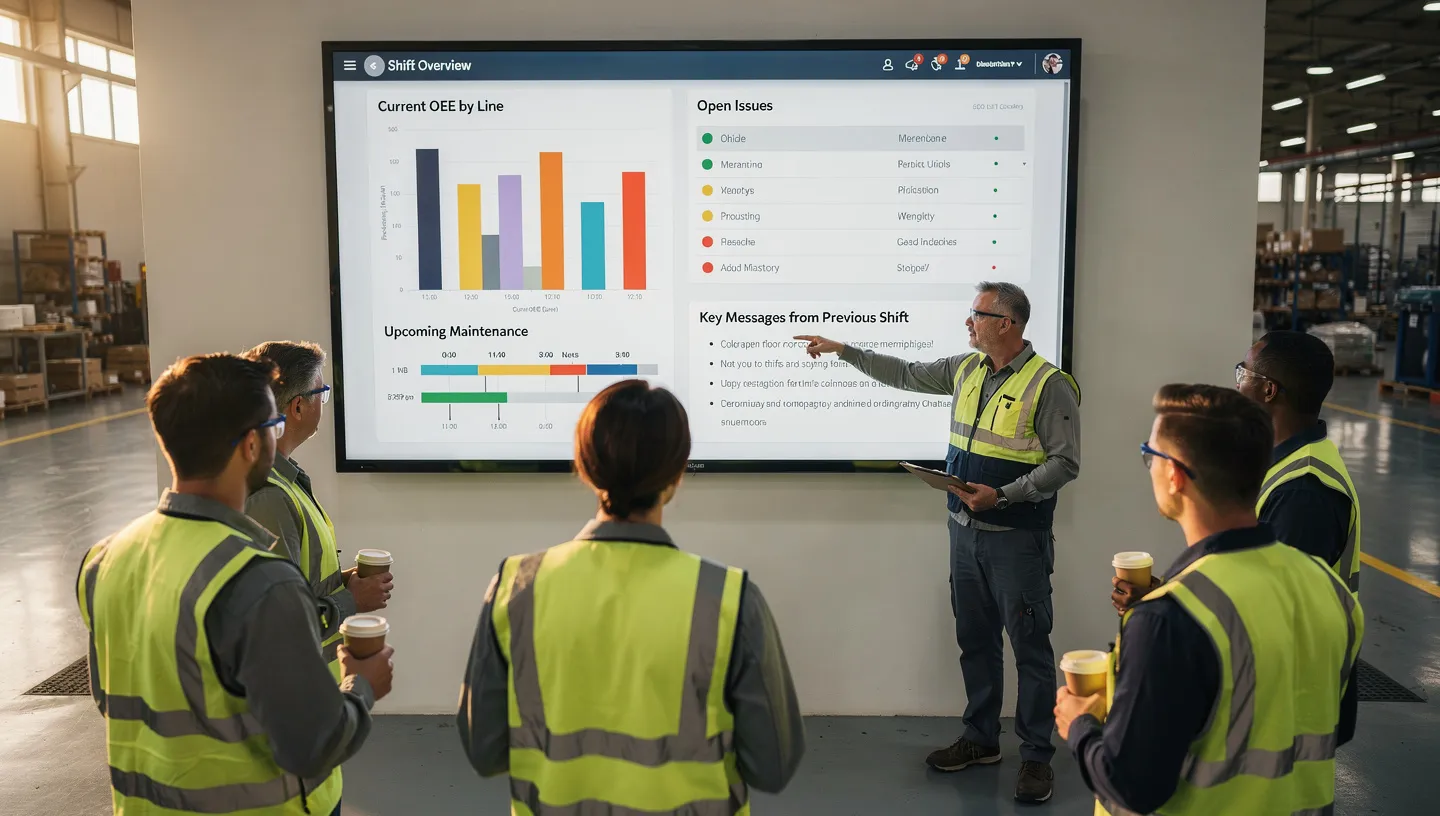
The daily direction setting meeting (called "daily management" or "DDS" in some plants) happens at the start of each shift. Attendees include the team leader, key operators, and sometimes the maintenance or engineering person. The meeting reviews: what happened on the previous shift, what is the target for the current shift, what problems are open, and what are we going to do about them today?
The meeting starts with the handover information. The previous shift's log entry is pulled up, reviewed, and discussed. Issues are clarified. Decisions are made about what the incoming shift will prioritise. Without good handover documentation, this meeting is a dead zone: people guess about what happened, conversations go in circles, and decisions are weak because they are based on incomplete information.
With good handover, the meeting is efficient and purposeful. It is the mechanism that ensures continuity and breaks the "shift gap" pattern. Handover quality directly affects the quality of daily management, which directly affects production performance.
Common pitfalls
Handover systems fail in predictable ways:
No written record
Teams rely entirely on conversation at shift change. Weeks later, someone asks "did we ever find out what caused that quality issue in February?" and no one remembers. A permanent record, even an imperfect one, beats relying on memory.
Inconsistent content
Some operators log everything; others log nothing. Some shifts are verbose; others are cryptic. Incoming shift does not trust what is in the logbook because the coverage is unreliable. Trust erodes and the system becomes ceremonial rather than useful.
No clear action owners
The logbook says "check sensor accuracy." No one is assigned. No deadline is set. The item floats forward day after day, never actually gets done, and everyone assumes someone else is handling it.
No review or follow-up
Team leaders or supervisors do not regularly read shift logs or hold the team accountable for quality entries. The logbook becomes a filing cabinet for forgotten thoughts rather than a live management document.
Too much detail
Handovers that capture every minute of the shift (every small stop, every transient alarm) create noise that drowns out signal. The next shift cannot find the critical information. Too much content is as bad as too little.
Handover only at shift change
Some operations try to compress all handover into the 10 minutes of shift overlap. For complex issues, this is not enough time. Better to start the handover conversation early, document ongoing discussions during the shift, and finalize at change.
Measuring handover quality
Unlike OEE, which has a single metric, handover quality is multidimensional. But you can measure it.
Completeness. Does each handover entry cover the six topics: equipment status, open issues, safety, quality findings, production targets, and actions? Sample 10 entries and see what percentage cover all six categories.
Timeliness. Are entries filled in during or immediately after the shift, or are they written retroactively hours later? Entries written late are less accurate and less useful.
Adoption. What percentage of documented issues or findings from the shift log are referenced in the daily management meeting the next day? If most entries are ignored, the system is not working.
Resolution rate. Of the open issues logged, what percentage are actually resolved or escalated, versus lingering indefinitely? A high proportion of zombie open items suggests the logbook is not connected to problem solving.
Operator feedback. Ask the incoming shift: "How useful was the previous shift's logbook entry?" A simple 1-5 scale, recorded quarterly, tells you whether the system is solving the problem it was designed for.
You cannot improve what you do not measure. Even simple weekly metrics (completeness %, adoption %, resolution rate %) will expose whether handover is functioning.
Shift handover and digital tools
Paper logbooks work but do not scale. They are hard to search, easy to misplace, and do not connect to production or maintenance systems. Digital tools solve these problems but only if they are designed with operational reality in mind.
A shift handover system should have these capabilities: Quick entry form with templated fields (makes entries consistent and fast). Mobile-friendly interface (operators fill it in at shift change, often standing on the floor, not at a desk). Search and filter by date, shift, equipment, or keyword (critical for finding historical context). Integration or linking to production targets, defect logs, and maintenance history (so the entry is not isolated data, it connects to the story). Read-only review mode for the incoming shift (they read the logbook, ask clarifying questions, and confirm understanding before they start). Audit trail (who wrote what, when, and was it updated).
The most effective implementations also include a lightweight flag or escalation mechanism: if an issue is marked "urgent" or "safety," it appears in a dashboard alert or gets sent to the team leader's phone. This closes the loop: logging an issue is not enough. It must trigger action.
Real-time visibility also changes behaviour. When team leaders know that every shift's log entry will be read and reviewed, quality of entries improves dramatically. When the incoming shift knows they have a 10-minute window to read and ask questions before their shift officially starts, they take handover seriously. Digital tools make this accountability visible.