What is TPM?
Total Productive Maintenance (TPM) is a management system where everyone in the organization takes responsibility for maintaining equipment and preventing losses. It's a fundamental shift from the traditional model where maintenance is a separate department's job and production operators run machines and report breakdowns.
In TPM, operators perform daily maintenance tasks on their equipment, maintenance technicians focus on strategic improvements rather than reactive fixes, and the entire plant works together to eliminate equipment-related losses. The goal is not perfect maintenance, but perfect equipment health that enables continuous, defect-free production.
TPM originated in Japan in the 1960s and became a cornerstone of lean and continuous improvement systems worldwide. It underpins modern operational excellence frameworks and is embedded in systems like Integrated Work Systems (IWS) and lean manufacturing.
The origins of TPM
Preventive maintenance (PM) was the dominant maintenance philosophy before TPM emerged. In PM, maintenance technicians follow a fixed schedule: change oil, replace filters, inspect bearings, whether the equipment needed it or not. The logic was simple: regular service prevents breakdowns.
In the 1960s, Seiichi Nakajima at the Japan Institute of Plant Maintenance (JIPM) observed that preventive maintenance wasn't enough. Some equipment still broke down unexpectedly. Maintenance was expensive and reactive. More importantly, production operators had no responsibility for equipment condition, so they ran machines hard, ignored early warning signs, and reported failures after they happened.
Nakajima realised that the root cause was ownership. If only maintenance owned equipment health, production would never prioritize it. If operators felt responsible for their machines, they would catch problems early, operate within limits, and notice abnormalities before breakdowns occurred. This insight led to Total Productive Maintenance.
TPM evolved from PM in three ways. First, it distributed maintenance responsibility across the entire operation, not just to technicians. Second, it moved the focus from fixing failures to preventing them before they start. Third, it integrated equipment maintenance with continuous improvement, quality, safety, and cost. Equipment health became everyone's job.
The eight pillars of TPM
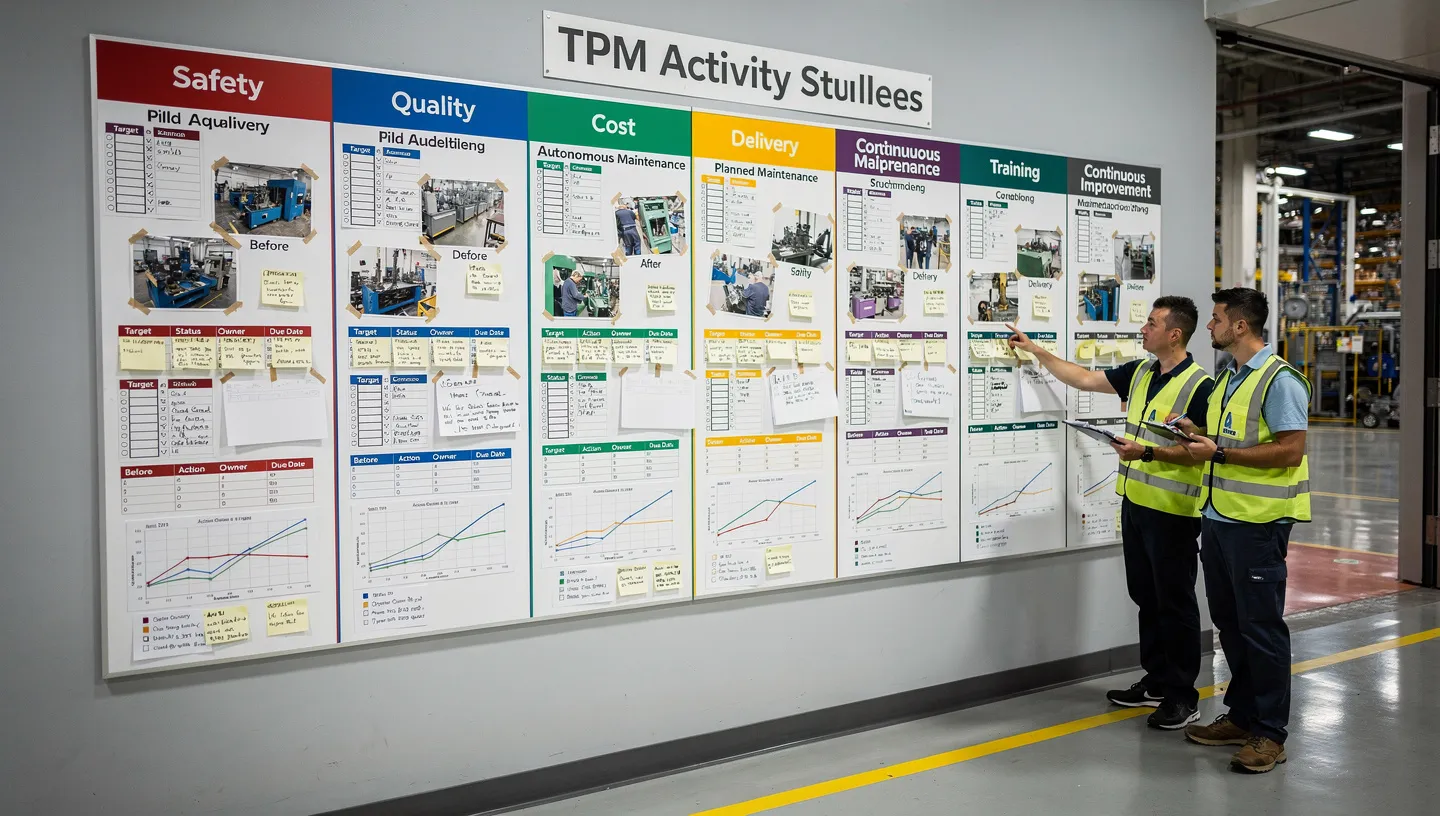
TPM is built on eight supporting pillars, each addressing a different dimension of equipment health and operational effectiveness. All eight must be developed together to create a complete system.
Autonomous Maintenance
Operators perform daily maintenance tasks on their equipment: cleaning, inspecting, lubricating, identifying abnormalities. This keeps equipment in good condition and gives operators early warning of problems.
Planned Maintenance
Maintenance technicians follow a strategic, data-driven schedule. Inspections, component replacements, and overhauls are planned based on equipment condition and failure patterns, not just elapsed time.
Focused Improvement
Cross-functional teams tackle the biggest equipment losses with structured problem-solving. They use tools like SMED (for changeovers), why-why analysis (for breakdowns), and design reviews to eliminate chronic problems.
Education and Training
Operators and technicians gain the knowledge to understand their equipment, diagnose problems, and improve it. Training ranges from basic daily maintenance to advanced troubleshooting.
Early Management
New equipment is designed, installed, and brought into production with TPM in mind. Equipment reliability is maximized from the start rather than discovered after months of operation.
Quality Maintenance
Equipment condition is linked directly to product quality. Systematic inspection and correction prevent quality losses, not just production losses.
Safety and Maintenance
Equipment safety is a core maintenance responsibility. Unsafe equipment conditions are identified and corrected as rigorously as any other loss.
Office TPM
TPM extends beyond the production floor to support functions: maintenance management systems, spare parts processes, engineering, and planning all operate with TPM discipline.
In an immature TPM system, one or two pillars dominate (usually autonomous maintenance and reactive planned maintenance). In a mature system, all eight are developed in parallel and support each other. Quality maintenance, for example, only works if autonomous maintenance is creating early visibility into equipment condition.
Autonomous maintenance in depth
Autonomous maintenance is the most visible and foundational pillar of TPM. It's where daily ownership begins. The goal is for operators to maintain their equipment in good condition through systematic daily and weekly tasks, and to notice when something is wrong before it breaks.
Autonomous maintenance progresses through seven steps, typically taking 6 to 12 months to mature. Each step builds on the previous one.
Initial cleaning and inspection
Operators thoroughly clean their equipment while learning its components and normal condition. Cleaning often reveals hidden defects, leaks, loose fasteners, and wear that get fixed immediately. The goal is to establish a baseline of what "good" looks like.
Eliminate dust, oil, and contamination sources
Operators and maintenance identify and fix the sources of contamination and deterioration. Better seals, improved covers, scheduled lubrication, and process changes prevent the problems that cleaning revealed. Equipment stays clean longer because the causes of dirt are removed.
Create maintenance standards
Working with technicians, operators develop written standards for each daily and weekly maintenance task. Standards include what to do, how to do it, why it matters, and how to recognize when something is wrong. These become the routine for every shift.
Inspect and diagnose equipment condition
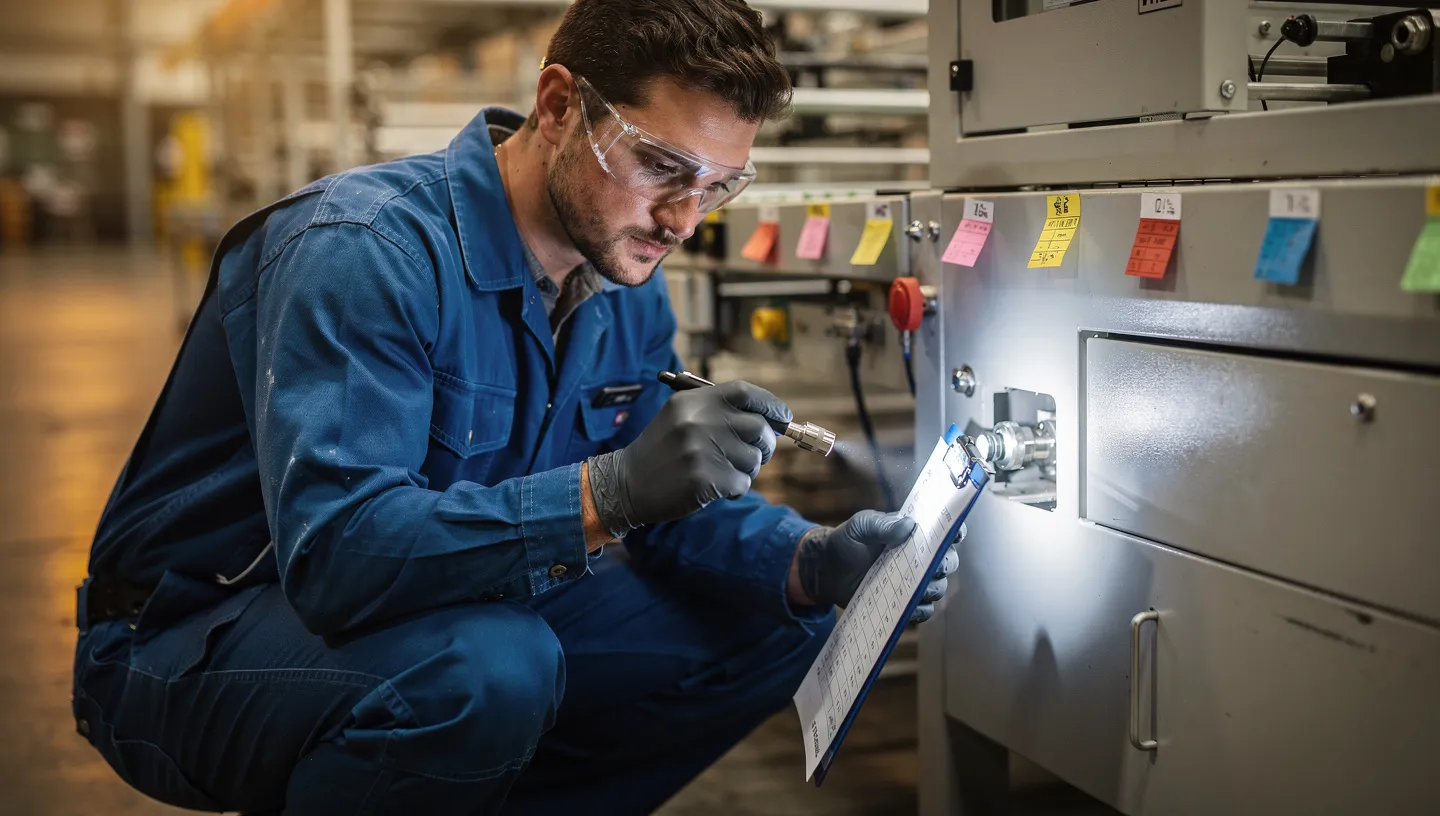
Operators learn to detect abnormalities: unusual sounds, vibrations, temperatures, leaks, or wear patterns. They use structured checklists to inspect their equipment daily, identifying problems early before they cause downtime.
Standardize inspection processes
Inspection standards are refined based on what operators have learned. Equipment history, failure patterns, and known weak points inform inspection frequency and focus areas. A bearing that fails every 18 months gets monthly attention. Robust components get yearly inspection.
Monitor and maintain management control
Operators track their own performance against maintenance standards. Completion rates, defect discovery rates, and quick fixes are visible daily. When standards slip, they're reinforced. The discipline becomes part of shift routine.
Autonomous management systems
Operators manage their equipment maintenance fully, including deciding when maintenance is needed, prioritizing fixes, coordinating with technicians, and tracking spare parts. Maintenance becomes their responsibility, not something done to their equipment.
The operator role in TPM
In a TPM system, operators are no longer just production workers who run machines and report problems. They become stewards of equipment condition, the first line of defense against losses, and active contributors to improvement.
Every operator maintains their equipment daily through autonomous maintenance tasks: cleaning, lubricating, inspecting for leaks or abnormal wear, and tightening loose fasteners. These aren't occasional tasks. They're part of the daily routine, usually taking 10 to 15 minutes at the start or end of each shift.
Operators also participate in daily direction setting meetings, called stand-ups or huddles, where the previous shift's equipment performance is reviewed. What were the biggest losses? Why did they occur? What's being done about them? This conversation makes operators active problem-solvers rather than passive reporters.
When operators discover equipment problems through their daily maintenance, they use standard escalation. Minor issues are fixed immediately if they have the skills and authority. Bigger issues are reported to maintenance with clear description of the problem and its impact. In mature TPM systems, operators and maintenance technicians work side-by-side to diagnose and fix problems.
This shift requires training, clear standards, management support, and time. Operators cannot be expected to maintain TPM discipline if they're pressured to produce at all costs, if equipment failures aren't addressed quickly, or if management doesn't acknowledge their contribution. In the strongest TPM cultures, operators are recognized as the experts in their equipment.
TPM and Integrated Work Systems
TPM and Integrated Work Systems (IWS) are complementary frameworks. They're often confused or thought to compete, but in practice they reinforce each other.
TPM focuses specifically on equipment maintenance and reliability. Its tools are autonomous maintenance standards, planned maintenance schedules, focused improvement projects, and equipment-focused training. TPM answers the question: how do we keep equipment in the best possible condition?
IWS is a broader management system that integrates multiple elements: equipment reliability (through TPM), continuous improvement, visual management, standard work, safety, quality, and people development. IWS answers the question: how do we run a manufacturing operation where losses are visible, standard, and eliminated continuously?
In an IWS system, TPM is the equipment pillar. OEE is the performance metric. Continuous improvement (using tools like Kaizen and SMED) is the problem-solving method. Daily meetings are the communication structure. Together, these elements create a coherent management system where operator engagement, visible performance, and structured improvement reinforce each other.
Common pitfalls
TPM implementations often fail because they encounter predictable obstacles. Learning to recognize and avoid them dramatically increases success rates.
Treating TPM as a maintenance project
TPM is a cultural and operational shift, not a maintenance improvement project. If the plant manager sees it as "fixing the maintenance department," it will fail. TPM requires commitment from operations, maintenance, engineering, and plant leadership. It requires time investment, discipline, and patience to mature.
Skipping the early steps of autonomous maintenance
Plants often jump from step 3 (cleaning) straight to step 7 (autonomous management), expecting operators to manage their own maintenance immediately. Skipping steps 4, 5, and 6 (learning to inspect and diagnose) means operators don't have the skills to notice problems. Compliance without competence creates false TPM.
Insufficient training
Operators cannot maintain what they don't understand. Many TPM implementations assume operators already know how their equipment works. In reality, most operators have never been trained on equipment basics. TPM requires investment in understanding mechanical and electrical systems, failure modes, and diagnostic techniques.
Weak equipment history and failure analysis
Planned maintenance without good data is guesswork. If the plant doesn't track which components fail, when they fail, and why, planned maintenance schedules become arbitrary. TPM requires accurate equipment history so that maintenance can be targeted at the actual failure risks, not assumed ones.
Maintenance unprepared for operator engagement
Operators often encounter resistance from maintenance technicians who see TPM as threatening their expertise or job security. If maintenance doesn't embrace the role of enabling and training operators, the system breaks down. Technicians must transition from "doing all maintenance" to "teaching operators and handling complex repairs."
No clear link to business results
TPM takes months to show impact. If plant leadership doesn't understand the link between equipment health and production performance, budget and support will disappear during the implementation valley. TPM must be connected explicitly to OEE, MTBF, defect reduction, and cost.
Measuring TPM success
TPM maturity is measured through multiple metrics, each showing a different aspect of system health.
OEE (Overall Equipment Effectiveness) is the headline metric. In an immature operation, OEE might be 45% with frequent breakdowns and high defect rates. As TPM matures, OEE climbs to 65%, then 75%, then 85%. World-class operations sustain 85%+ OEE because equipment reliability is embedded in the system.
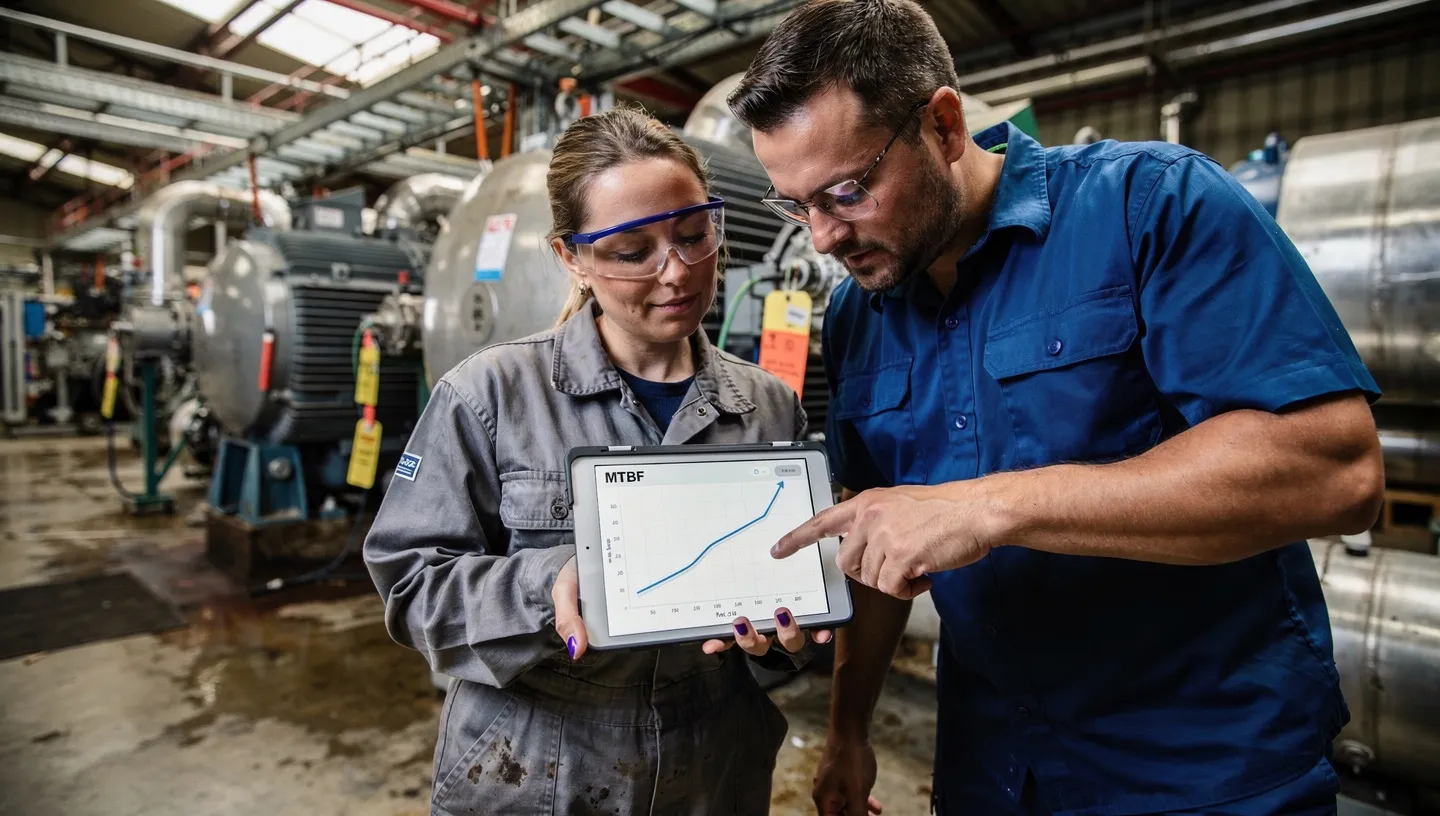
MTBF (Mean Time Between Failures) measures equipment reliability. A machine failing every 100 hours has an MTBF of 100. As TPM takes hold, chronic failures are eliminated and MTBF increases. A 50% increase in MTBF indicates that root causes of failures have been addressed through focused improvement.
MTTR (Mean Time To Repair) measures how fast failures are fixed when they do occur. With good diagnostics, spare parts availability, and technician expertise, MTTR should be short. TPM targets both preventing failures (high MTBF) and fixing them quickly (low MTTR).
Autonomous maintenance completion rates show whether operators are maintaining standards. A plant where operators are cleaning and inspecting equipment daily is different from one where they're ignoring maintenance tasks because they're too busy producing. Completion tracking is a leading indicator of TPM health.
Focused improvement project completion shows whether the plant is systematically eliminating the biggest losses. A plant running 10 improvement projects per year on equipment losses is different from one running none. Closure rate matters: projects that are started and abandoned waste credibility.
Spare parts availability tracks whether equipment failures can be fixed without waiting for parts. In mature TPM, critical spare parts are in stock or on rapid order, not scavenged from other equipment or cannibalized from spare machines.
TPM and digital tools
Digital systems don't create TPM culture, but they enable it at scale. A plant of 100 operators managing autonomous maintenance through paper checklists faces challenges: which checklist are they on today, did they complete it yesterday, who's accountable if it's missed? Digital systems solve these problems, freeing operators and technicians to focus on the work, not the paperwork.
Maintenance management systems (CMMS) are the traditional tool, tracking planned maintenance schedules, work orders, spare parts, and equipment history. Digital CMMS systems make this data accessible and real-time, rather than buried in filing cabinets.
Mobile-first TPM tools let operators complete daily checklists and report problems from the floor, not from a desktop hours later. Photos and notes can be attached to each checklist item, creating a visual record of equipment condition over time.
Real-time OEE dashboards show how equipment health translates to production performance. Operators and maintenance technicians see the direct link between their efforts and the metrics that matter: uptime, speed, and quality.
Connected equipment sensors provide early warning of degradation. Temperature trending, vibration analysis, and acoustic monitoring can detect bearing wear or lubrication problems before they cause failure. TPM discipline combines this data with operator observation to guide maintenance decisions.
The most effective digital TPM systems integrate equipment data, maintenance work orders, operator checklists, and improvement actions into one system. When a sensor alerts to equipment degradation, maintenance can schedule work in context of the autonomous maintenance history and current equipment condition, not in isolation.