What is lean manufacturing?
Lean manufacturing is a systematic approach to eliminating waste and optimizing production flow. It starts with a simple principle: every activity in a manufacturing process either adds value to the product or customer, or it doesn't. Anything that doesn't add value is waste. Lean focuses on identifying and removing that waste.
Unlike traditional manufacturing, where the goal is to keep all equipment busy and workers occupied, lean asks a different question: what is the fastest, most efficient way to deliver what the customer actually needs? This shift in thinking leads to fundamental changes in how work is organized, how problems are solved, and how improvement happens.
Lean manufacturing has become the foundation for operational excellence across industries. It applies not only to discrete manufacturing (auto, electronics, machinery) but also to process industries, healthcare, logistics, and even office environments. The core principles are universal, though the tools and application methods vary by context.
Origins and evolution
Lean manufacturing emerged from the Toyota Production System (TPS), developed after World War II when Toyota lacked the capital and resources that Western manufacturers had. Taiichi Ohno and Shigeo Shingo, Toyota's chief engineers, created a system based on the idea that waste was the real problem to solve, not inefficiency in how fast things ran.
In the 1950s and 1960s, while Western manufacturers built huge facilities and kept machines running 24/7, Toyota built smaller plants, made in smaller batches, and involved all workers in finding problems and fixing them. The results were striking: lower costs, higher quality, better customer responsiveness, and more engaged employees.
For decades, the Toyota Production System remained largely hidden from the West. It was only in the 1990s, when MIT researchers James Womack and Daniel Jones studied the auto industry, that they codified and popularized the principles in their book "The Machine That Changed the World." They coined the term "lean" to describe this approach, and it spread rapidly across industries.
The five lean principles
Womack and Jones distilled TPS into five key principles that form the backbone of lean thinking:
1. Value
Define what adds value from the customer's perspective. This is not what the manufacturer thinks is important, but what the customer is willing to pay for. Everything else is waste.
2. Value stream
Map the entire flow from raw material to finished product. Identify every step and categorize it as value-adding, necessary but non-value-adding, or pure waste. Most processes have far more waste than anyone realizes.
3. Flow
Eliminate delays, queues, and batching. Organize production so that material and information flow continuously from one step to the next without interruption. Flow is the opposite of batch-and-queue thinking.
4. Pull
Make only what is needed when it is needed. Production is triggered by actual customer demand, not by forecast or schedule. Pull systems prevent overproduction and reduce inventory.
5. Perfection
Eliminate waste is never finished. Build a culture where finding and fixing problems is everyone's responsibility. Continuous improvement is the destination, not the end state.
These principles are not steps to follow sequentially. They are interconnected. You cannot achieve pull without flow. Flow requires knowing the value stream. And all of it depends on understanding what the customer values. Together, they form a system for thinking about manufacturing.
The eight wastes
The eight wastes (often remembered by the acronym DOWNTIME or TIMWOODS) are specific categories of non-value-adding activity. Learning to see waste is the first step in lean improvement:
Defects
Making parts that don't meet specification. Includes scrap, rework, and customer returns. Prevention through quality at the source is more efficient than finding and fixing defects later.
Overproduction
Making more than needed, faster than needed, or before needed. The most dangerous waste because it hides other problems: excess inventory masks quality issues, supply chain delays, and planning errors.
Waiting
Idle time while material, information, approvals, or people are unavailable. Includes operators waiting for parts, machines waiting for material, and engineers waiting for approval. Waiting is often invisible but has high impact.
Non-utilized talent
Not engaging the knowledge, ideas, and problem-solving capability of the people doing the work. Many organizations waste the biggest asset they have by not listening to employees.
Transportation
Unnecessary movement of material between processes. Includes long distances between operations, multiple handling steps, and complex logistics. Often the result of poor plant layout or large batch thinking.
Inventory
Excess material sitting in buffers, waiting to be processed. Ties up capital, hides problems, occupies space, and often becomes obsolete. Lean aims to reduce inventory to just what is needed right now.
Motion
Unnecessary movement by people or equipment to accomplish a task. Examples include searching for tools, reaching for parts, or extra keystrokes. Small motions multiply into hours of wasted effort per day.
Excess processing
Features, tolerances, or steps that exceed what the customer requires. Over-engineering, unnecessarily tight specifications, or redundant checks add cost without adding value.
The eight wastes framework is a scanning tool. Walk through a process and ask: where do we see defects, overproduction, waiting, untapped talent, transportation, inventory, unnecessary motion, or excess processing? The answer tells you where to focus improvement effort.
Key lean tools and practices
Lean has developed a toolkit of specific methods and practices. The tools are secondary to the principles, but mastering them accelerates improvement:
Value stream mapping (VSM)
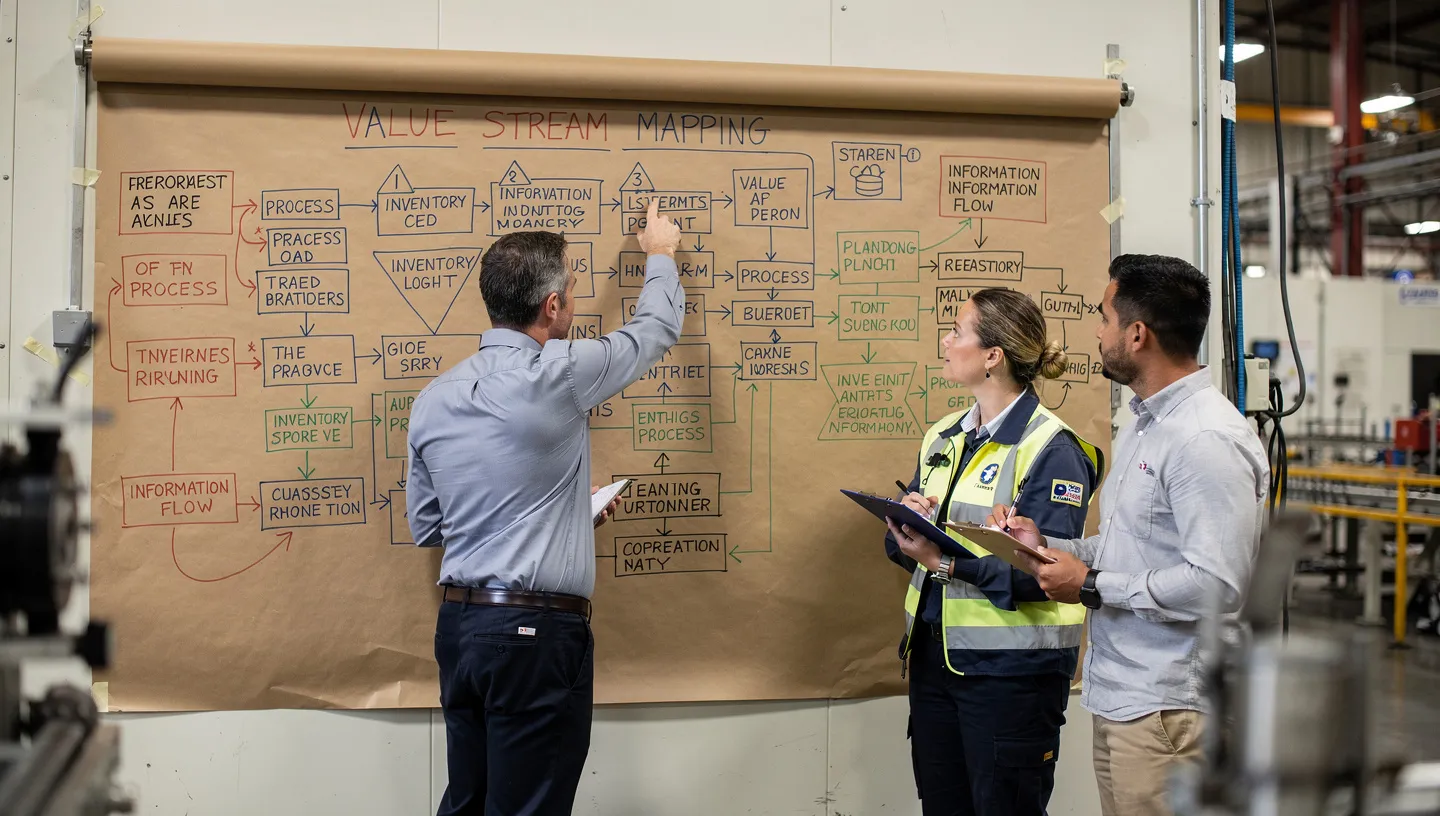
A visual representation of all the steps, delays, and flows involved in delivering a product from raw material to customer. VSM shows both the material flow and the information flow. Each step is labeled with cycle time, changeover time, inventory held, and quality checks. The map reveals where time is spent on value-adding work versus waiting and handoffs. Most value stream maps reveal that actual production time is 5% of total lead time, with 95% in queues and delays.
Kanban
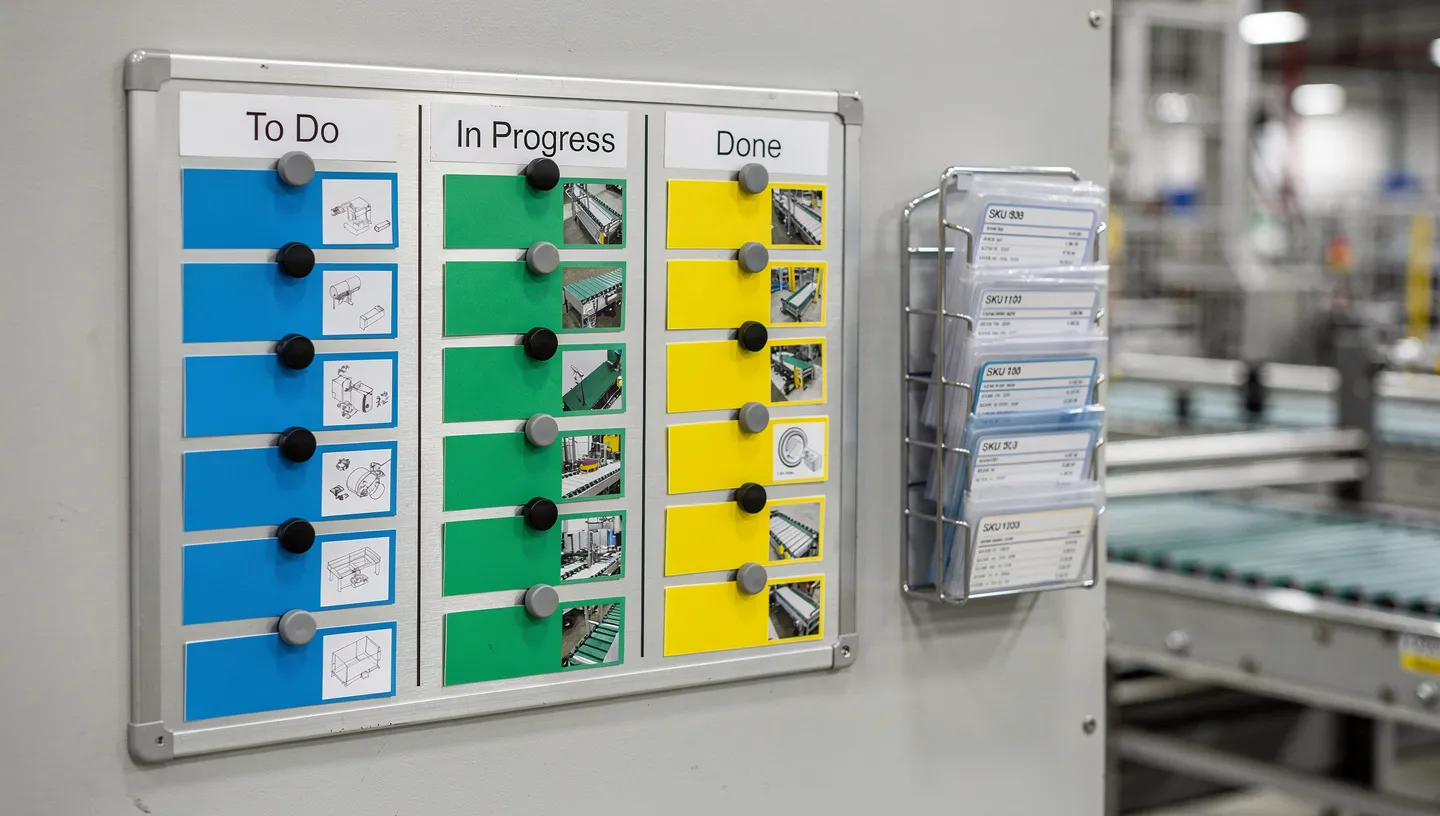
A pull system using visual signals (cards, bins, lights) to trigger production. When material is consumed, a kanban signal tells the supplying process to make more, only enough to replenish what was used. Kanban limits work-in-progress, prevents overproduction, and makes demand visible throughout the process.
5S
A foundational workplace organization system with five steps: sort (remove unnecessary items), set in order (organize what remains), shine (clean and inspect), standardize (define the right way to maintain), and sustain (build it into daily habit). 5S makes the workspace easier to work in and makes problems visible.
Poka-yoke (error-proofing)
Designing processes to prevent mistakes from happening in the first place, or making them immediately obvious if they do occur. Examples include physical guides that prevent wrong parts from being inserted, color-coded materials, or automatic stops when conditions are wrong. Poka-yoke is more reliable than inspection.
Heijunka (production leveling)
Smoothing the production schedule to level out demand and reduce variability. Instead of making large batches of one product, then switching to another, heijunka spreads different products throughout the day in small quantities. This reduces inventory buildup and makes staffing more stable.
SMED (Single-Minute Exchange of Dies)
A method for reducing changeover time from hours to minutes. SMED separates external activities (that can be done while the machine runs) from internal activities (that require the machine to stop). By doing external work in parallel and simplifying internal work, changeover times drop dramatically. Shorter changeovers enable smaller batches and more frequent switches.
Lean in process industries
Lean thinking originated in discrete manufacturing (automotive, electronics) where you can see individual products moving through discrete steps. But the principles apply equally to process industries: food and beverage, pharmaceuticals, chemicals, refining, and materials processing.
Process industries often think lean is not relevant because they believe they are fundamentally different. Continuous processes don't have changeovers. Material flows as a stream, not as discrete units. Quality is controlled by recipe, not inspection at discrete steps.
This is true, but it misses the point. Process industries still have waste: lost production time due to equipment failures or feed problems, inventory sitting in tanks waiting for the next step, recipes and procedures that are unnecessarily complex, batches that are too large, and variability in input materials that ripples through the entire process.
Process industries benefit enormously from lean tools adapted to their context. Value stream mapping reveals bottlenecks in a continuous system. Kanban-style pull systems work with batches and managed tanks instead of discrete bins. 5S is even more critical in process environments where a small leak or accumulation of material can be dangerous. Poka-yoke and standardized procedures prevent recipe errors and operator variation. The philosophy is identical. The implementation details differ.
Common pitfalls
Lean improvement is not automatic, and well-intentioned efforts often stumble:
Treating lean as a cost-reduction exercise
Lean is sometimes launched as a way to cut headcount or speed up work. This creates resistance and teaches people to hide problems rather than expose them. Lean works best when the goal is explicitly to improve service to the customer and respect people, not to eliminate jobs. When lean improvements do result in fewer people, the organization needs to be prepared to redeploy them.
Implementing tools without understanding principles
Many organizations adopt kanban, 5S, or VSM because they have seen them work elsewhere, without understanding the thinking behind them. They paint kanban cards and reorganize storage, but these are surface changes. Without changing how decisions are made and problems are solved, tools become temporary exercises that fade.
Assuming continuous improvement is the job of improvement specialists
Lean works when every operator, supervisor, and team leader identifies problems, proposes solutions, and tests them. Assigning improvement to a lean team or consultant creates a dependency. The goal should be to make improvement part of normal work for everyone.
Confusing speed with flow
Some organizations apply lean by simply pushing work faster, encouraging workers to rush, or increasing targets. Actual lean is about eliminating the delays and handoffs that slow the system. Speed comes from flow, not from pushing harder.
Focusing on cost instead of problems
Lean improvement should be driven by the problems you see in the process, not by a target cost reduction. When the focus is cost, you get 6-month projects that find quick wins and end. When the focus is on solving problems, improvement is continuous and often yields greater savings.
Lean and operational excellence frameworks
Lean is often part of a larger system for operational excellence. Understanding how lean connects to other approaches is important for sustaining improvement over time.
Integrated Work Systems (IWS) is a management system that uses lean principles as the foundation for how work is organized, measured, and improved. IWS adds structured daily management, clear accountability, and a framework for cascading improvement across the organization. Lean without this structure often produces pockets of excellence but fails to sustain or spread.
Total Productive Maintenance (TPM) extends lean thinking to equipment reliability and maintainability. Where lean focuses on eliminating waste, TPM focuses on building ownership and reliability. Together, they create a system where equipment downtime is minimized and everyone participates in keeping equipment healthy.
Continuous Improvement culture is the mindset that connects all these frameworks. It is the belief that there is always a better way, that problems are opportunities, and that the people doing the work are the experts. This culture cannot be mandated. It emerges when lean tools and frameworks give people the structure and permission to improve.
The most mature lean organizations are not necessarily the ones with the most sophisticated tools. They are the ones where problem-solving and improvement are normal parts of how work happens every day, and where respect for people is not a slogan but a practice.
Lean and digital tools
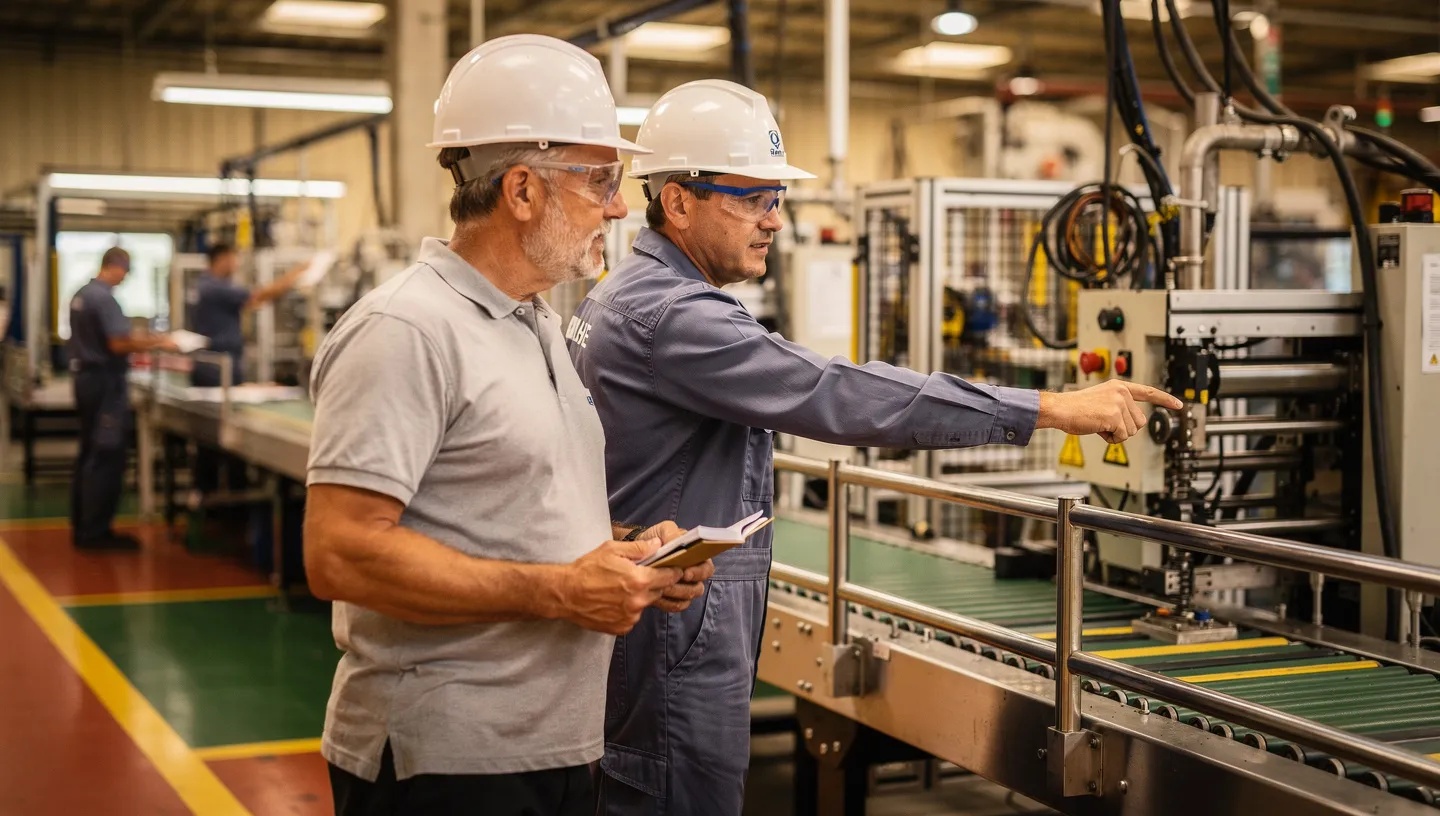
Digital tools are transforming how lean is practiced, though the principles remain unchanged. For decades, lean relied on visual management: kanban boards, andon lights, A3 reports, and gemba walks where leaders went to the floor to see problems firsthand.
Digital systems are extending the reach and speed of lean management. Real-time dashboards show OEE, production status, quality metrics, and equipment condition across multiple lines or plants. Data systems integrate VSM analysis with actual performance data, making it possible to track whether the flows you designed are actually happening. Digital kanban systems manage complex, multi-plant supply chains where paper would be impossible.
But digital also introduces a risk. Lean's power comes from face-to-face problem-solving on the floor. When leaders manage only through dashboards and reports, they lose the richness of understanding why problems happen. The most effective lean organizations integrate digital and visual: dashboards trigger gemba walks, data shows what changed, and people on the floor figure out why and what to do about it.