What is skills management?
Skills management is the process of identifying, developing, and maintaining the technical and behavioural competencies your workforce needs to perform their roles safely, reliably, and effectively. It bridges the gap between what your people can do today and what they need to do tomorrow.
Skills management sits at the intersection of three functions. Workforce planning identifies what skills will be needed (as roles change, new equipment arrives, or people retire). Training and development builds those skills. Quality assurance verifies that people actually have the skills they claim to have.
In manufacturing, skills management has unique urgency. Unlike office work, the consequences of skill gaps are immediate and visible. An operator without proper training causes defects, safety incidents, or slow production. A technician without troubleshooting skills means longer downtime. A supervisor without facilitation skills misses improvement opportunities.
Why it matters in manufacturing
Four pressures make skills management critical in manufacturing today.
Workforce ageing and turnover. The manufacturing workforce is ageing in most developed countries. Experienced people retire, taking decades of tacit knowledge with them. At the same time, younger workers have less shop-floor experience and expect more structured learning and career development. Traditional apprenticeship paths have shrunk, so companies must now create internal development pipelines.
Technology change. New equipment arrives with software interfaces, diagnostics, and automation that yesterday's experienced operators never encountered. Skills that were sufficient five years ago are no longer enough. Continuous upskilling is now the norm, not a one-time event.
Multi-skilling and flexibility. Single-skill specialists are less valuable in modern manufacturing. Plants need people who can work across multiple equipment, shift between roles, and understand how their work connects to the broader process. Multi-skilling increases flexibility and reduces dependency on any one person.
Regulatory and safety demands. Compliance regulations (GxP, ISO) often mandate proof that people are trained and qualified for their roles. Safety regulations require documented evidence that workers understand hazards and emergency procedures. Operator error contributes to both safety incidents and compliance violations. Well-documented skills management protects both your people and your certifications.
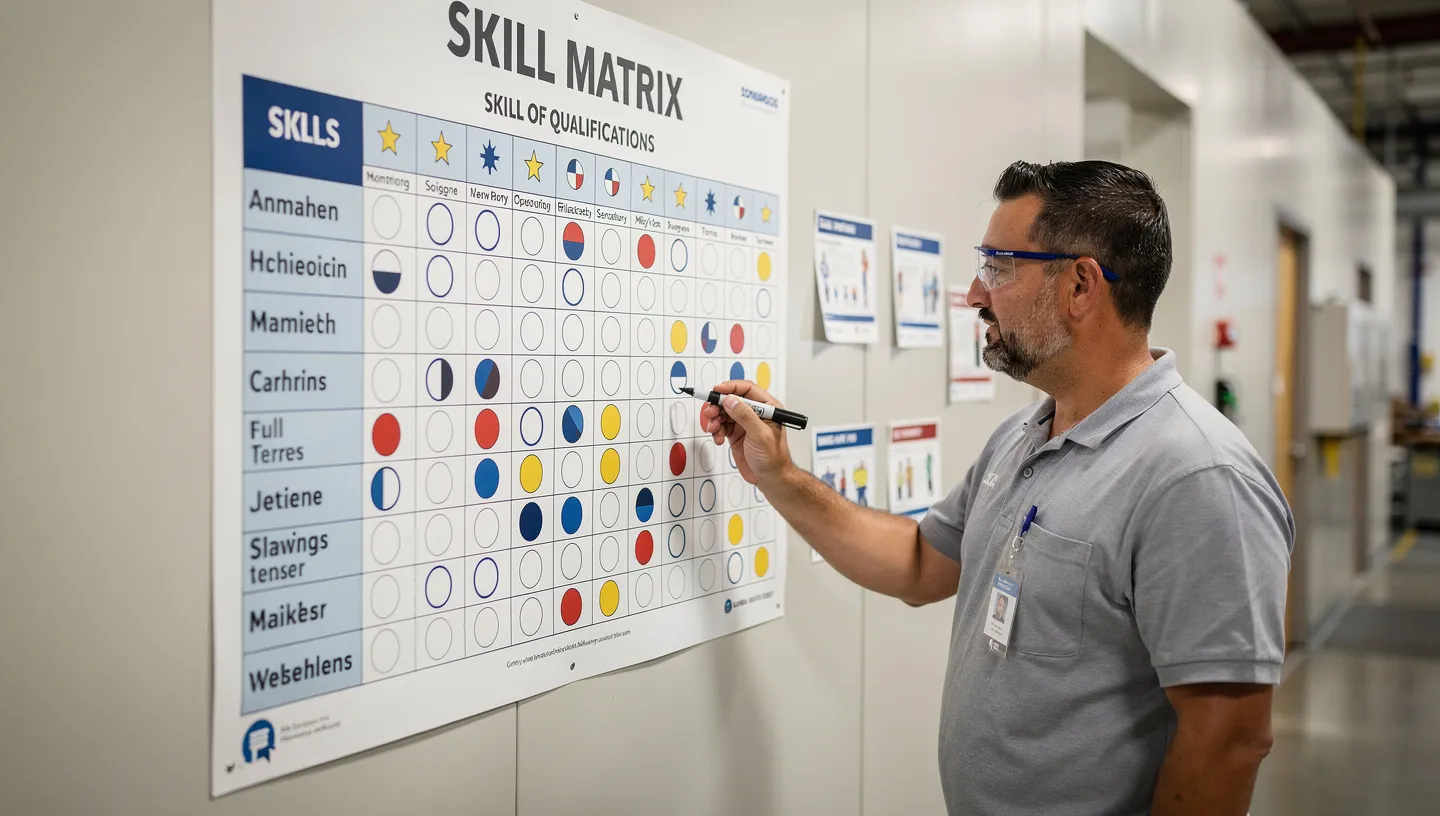
Skill matrices and competency frameworks
A skill matrix is a structured list of all the skills required in a role or team, with competency levels assigned to each person for each skill. It answers three simple questions about each person and skill combination. Can they do it? What evidence proves they can? When do they need refresher training?
Skills list
What needs to be learned
For an injection moulding operator: equipment setup, temperature control, visual inspection, changeover procedure, fault diagnosis, material handling, safety shutdown, quality measurement tools.
Competency levels
Depth of capability
Typical scale: Beginner (needs supervision), Intermediate (works independently), Advanced (trains others), Expert (improves the skill). Some frameworks use numerical scores (1-4) or colours (red, yellow, green, blue).
Evidence
How we know they have it
Formal training completion, on-the-job assessment, test score, supervisor sign-off, time working in role, product quality metrics, or incident-free performance over a specified period.
A competency framework goes deeper. It defines not just what skills are needed, but what "competent" actually means for each one. For "equipment changeover," what should a competent operator be able to do? How many minutes should it take? What steps must they follow? What are the common errors they must avoid? The framework answers these questions explicitly, so everyone has the same standard.
Frameworks should be role-specific. A production operator's changeover competency is different from a maintenance technician's. An entry-level operator needs different skills than a senior operator. Different equipment needs different skills, even within the same plant.
Types of training
Different skills require different training methods. The most effective plants use a mix.
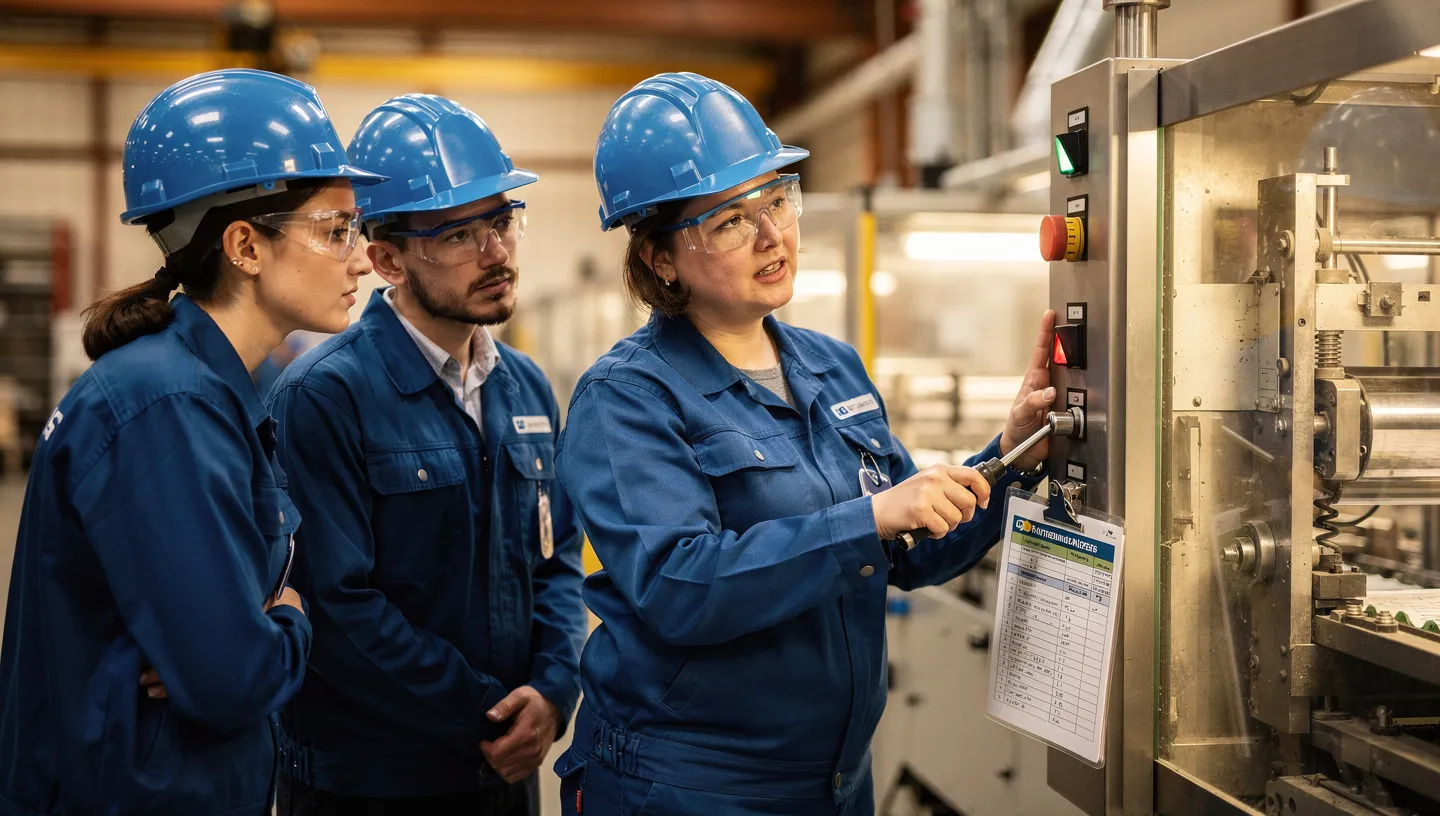
On-the-job training (OJT). Supervised practice at the actual equipment. The trainee works alongside an experienced operator or trainer, starting with simple tasks and graduating to more complex ones. OJT is irreplaceable for practical skills and for building confidence in the actual working environment. It's also quick and directly relevant. The risk is inconsistency. If the trainer is not structured or the learner is not attentive, gaps remain invisible.
Classroom or workshop training. Instructor-led sessions covering theory, procedures, and standards. Useful for teaching principles (why something matters, how it works) and standardised content. Less effective for muscle memory and real-time problem solving. Usually efficient when done in batches, but time away from the floor.
E-learning and digital modules. Self-paced online training. Scalable, consistent, traceable (you have records of who completed what). Good for knowledge that changes infrequently and doesn't require live feedback. Poor for building hands-on skills and for learners without easy access to devices or time away from production.
One-point lessons (OPLs). Short, focused training sessions (5 to 10 minutes) on a single topic. Often used on the shop floor to address a recent mistake or gap. OPLs are quick, timely, and forget-resistant because they happen at the point of use. They work best as reinforcement, not as initial training.
Mentoring and shadowing. A trainee observes a skilled person performing the full role in context. Effective for understanding the "why" behind procedures and for building real-world judgement. Time-intensive and dependent on the mentor's skill as a teacher, not just a practitioner.
Gap analysis and workforce planning
A skill gap is the difference between the skills people currently have and the skills they need to have. Identifying gaps is the first step to closing them.
Start by mapping current skills using your skill matrix. For each person-skill pair, record their current competency level (Beginner, Intermediate, Advanced). Then define the required competency level for each role. Compare the two. Any gap is an opportunity for training.
Gaps can be individual (one person is weak in a skill) or systemic (most of the team is weak). Individual gaps are closed through targeted training. Systemic gaps might signal that your skill matrix is out of date, or that your hiring didn't prioritise a needed skill, or that a key trainer recently left.
Workforce planning connects skill gaps to time. If three experienced operators retire in the next two years, you'll lose the advanced skills they hold. If your only expert in a critical procedure is 18 months from retirement, that's a strategic risk. Good workforce planning identifies these dependencies and funds development of successors.
Succession planning is the discipline of identifying people with high-potential or in critical roles and building them toward the next level. If your only PLC programmer is 55 years old, you need to be developing a replacement now, not when they resign.
Cross-training reduces dependency on any one person. If only one operator knows how to set up the sheet metal press, production stops when they're on holiday or absent. A good cross-training plan builds a minimum of two people at intermediate level for every critical skill, and at least one at advanced level.
Common pitfalls
Skills management fails in predictable ways.
Training without assessment
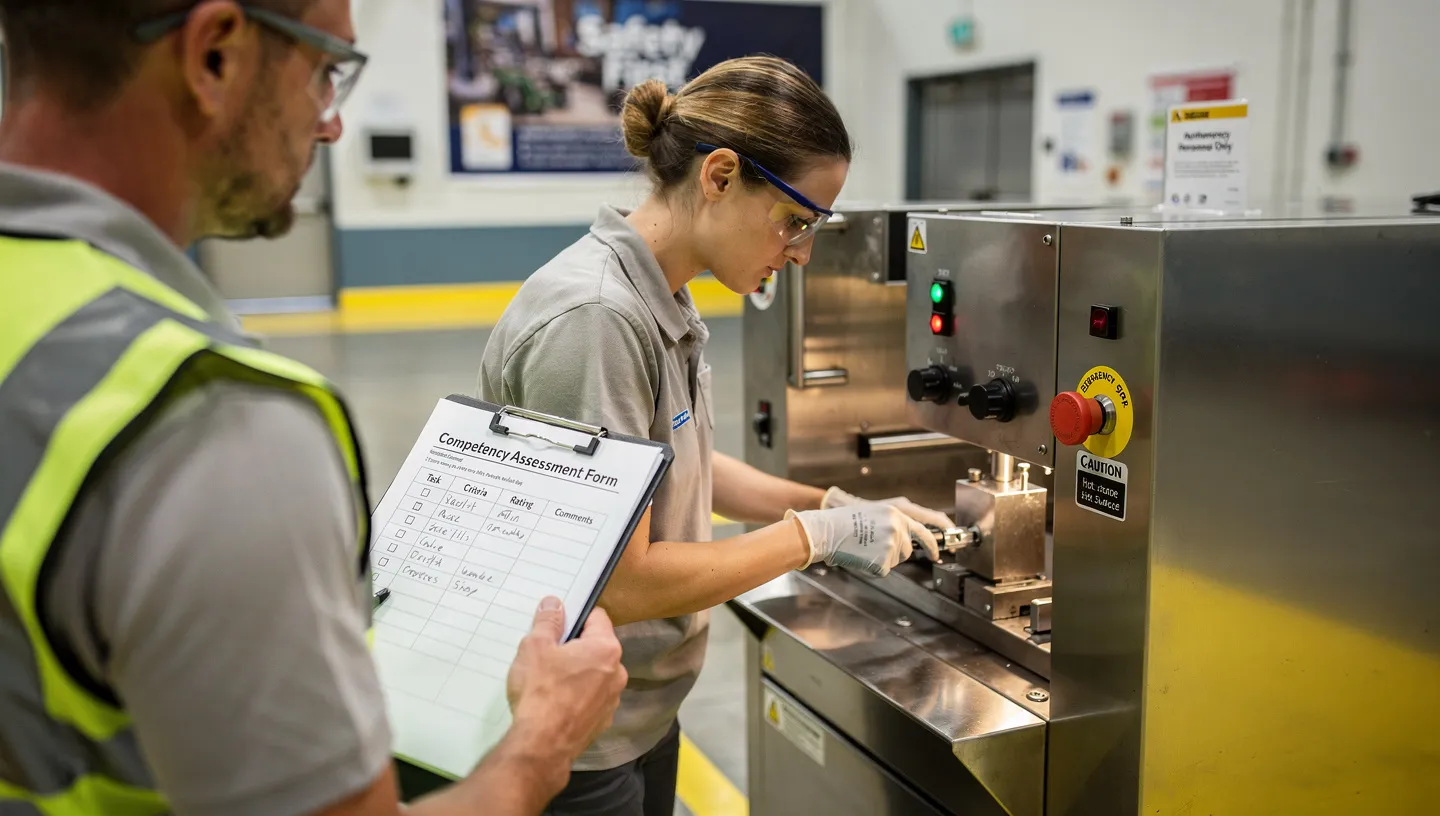
Someone attends a training course and gets a certificate, but no one ever checks whether they actually learned anything. The certificate becomes a checkbox, not proof of competency. Always pair training with assessment, whether that's a test, a supervised task, or sign-off from an observer.
Skill matrices that never get used
A skills matrix is created once, then sits in a folder and gets more out-of-date every month as people leave, new people join, and competencies degrade through lack of practice. Good matrices are live documents, updated whenever someone completes training or when someone's competency expires and needs refresher training.
Losing knowledge when people leave
If someone is the only expert in a critical area, and they leave without handing over, that knowledge is gone. Good plants have a transition plan when someone departs: document their most important skills, train their replacement well before the departure date, and have them work together for at least a few weeks.
Assuming experience equals competency
Someone has worked in a role for 10 years, so they must be an expert. But bad habits compound over time. An operator might have 10 years doing something the wrong way. Skills need to be assessed and refreshed, not assumed based on tenure.
No accountability for trainers
If anyone can do training whenever they feel like it, quality is inconsistent. Good plants define who is qualified to train, require trainers to refresh their teaching skills annually, and have supervisors observe training sessions occasionally to ensure standards are met.
Skills management and compliance
In regulated industries, skills management is not optional. It's a compliance requirement with specific demands.
GxP regulations (Good manufacturing practices in pharmaceuticals, food, biotech, medical devices) require documented proof that people are trained and qualified for their roles. "We assume everyone is competent" is not acceptable. You must have written evidence of training, assessment dates, trainer identification, and refresher schedule.
ISO 45001 (safety management) requires that workers have the competency needed to control risks. This includes understanding hazards, using equipment safely, and knowing what to do in emergencies. Documentation must demonstrate that competency is assessed and maintained.
ISO 14001 (environmental management) similarly requires trained, competent personnel to fulfil environmental obligations.
In these contexts, your skills management system needs to answer auditor questions explicitly. When an auditor asks "how do you ensure operators understand the environmental impact of this process?", the answer is not "we told them." The answer is documented training records, assessment results, refresher training schedules, and evidence that you track and verify ongoing competency.
Refresher training intervals are critical. A person qualified in a procedure is typically valid for 12-24 months, depending on how frequently they perform the task. If someone hasn't done something in two years, they need refresher training before doing it again, even if they were once qualified. Compliance audits check these records carefully.
Skills management and digital tools
Manual skills management, based on spreadsheets and paper records, works at small scale but breaks down in larger or more complex plants. Digital tools solve specific problems that manual systems struggle with.
Visibility and currency. A digital system makes it immediately clear who is qualified, who is not, and whose qualifications are expiring soon. A spreadsheet that no one has updated in three months tells you nothing. A live digital system shows current reality.
Role-based access. Supervisors can see and update training records for their team. Operators can see their own training history and upcoming refresher training dates. HR can generate compliance reports. Each role gets the information they need.
Automated reminders and alerts. When a qualification approaches its expiry date, the system alerts the supervisor and the person. Training is scheduled proactively, not reactively after someone is found to be expired.
Incident investigation support. When an incident occurs, investigation can quickly establish whether the person involved was properly trained and authorised for the task. This is critical for compliance, and also for identifying whether the incident reveals a training gap.
Workforce planning insight. Digital systems can report which people hold critical skills, when they're approaching retirement age, and what development pipeline is in place for their replacement. This feeds succession planning.
Digital tools are most effective when they connect to your broader operational systems. If training records sit in an isolated skills management system, no one uses them. When they integrate with your incident management system (so investigations automatically pull training records), your production scheduling (so you know who's authorised to run each line), and your compliance evidence (so you can generate audit reports directly), they become part of how the business actually operates.